Claude Memory vs. Business Memory: What's Actually Different
Updated November 2026
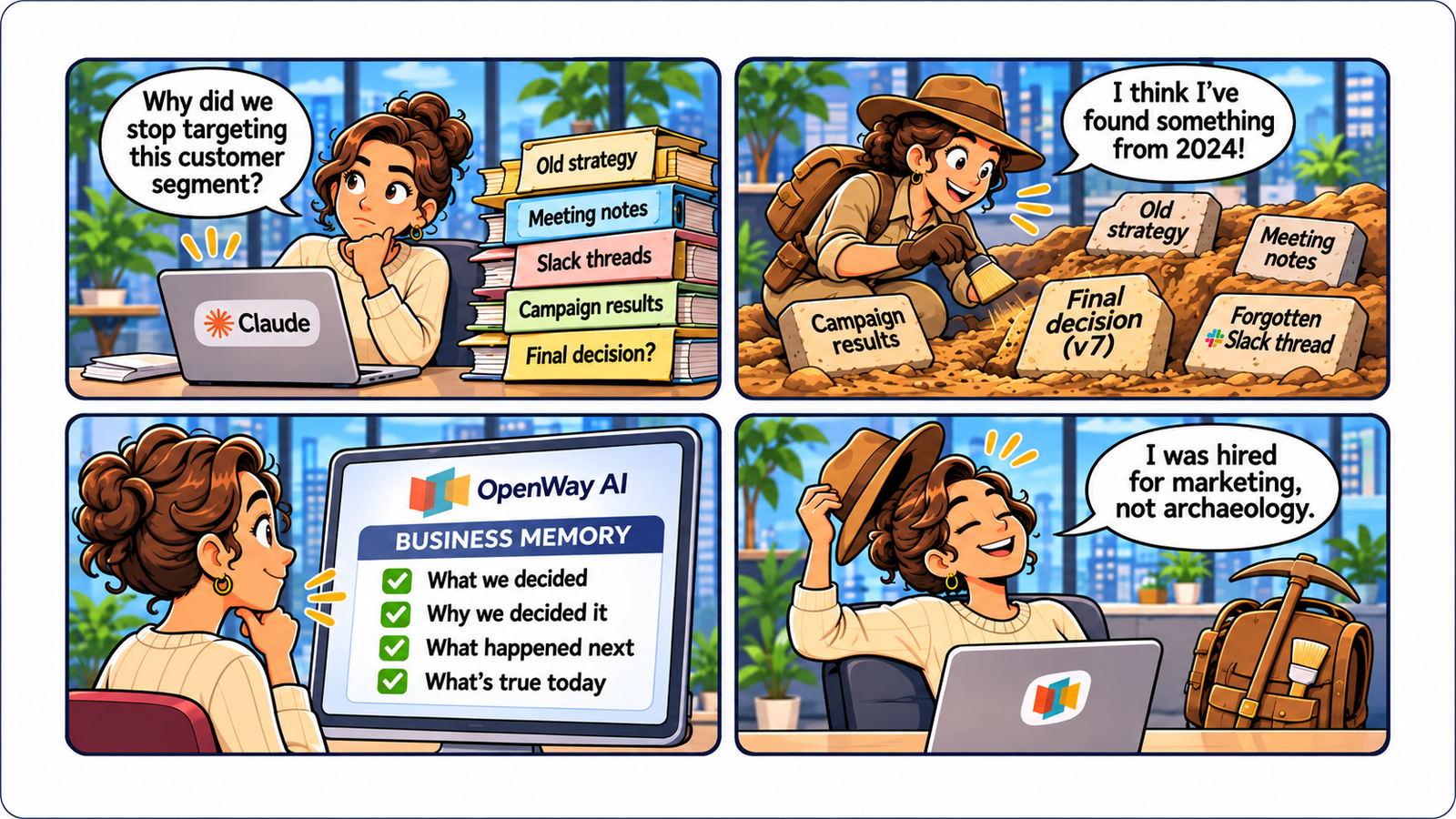
Imagine five people in your company use Claude every day. Six months later, each of them may be working with a slightly different understanding of your business. One has the current positioning, another may still be relying on last year's information, and a third knows why the company abandoned a particular strategy. The others may not even know that decision was made.
All five have AI with memory. Yet the company itself still has no shared business memory.
That's the problem business memory is designed to solve. It preserves what the company decided, why, what happened next, and which information is current today. With OpenWay AI, that same business memory is available to the whole team inside Claude, ChatGPT and Slack.
What do Claude's memory and Projects actually do?
Anthropic has developed two useful ways to maintain context in Claude: personal memory and Projects.
Claude's personal memory builds an understanding of your work from previous conversations. It can remember your preferences, responsibilities, ongoing tasks, and other details that help you pick up where you left off without explaining everything again.
Claude Projects provide a more focused environment for a particular body of work. You can add documents, establish instructions, and build up project-specific memory. On Team and Enterprise plans, Projects can also be shared with colleagues, subject to the organization's settings.
There's an important distinction, though. As Anthropic explains in its documentation, even when a Project is shared across an organization, individual conversations within that Project remain private unless users explicitly share them.
A marketing team can therefore work inside the same Claude Project while developing valuable insights in separate conversations. Sharing the Project doesn't automatically turn everything those employees learn into shared company knowledge.
What is business memory, and how is it different?
Business memory is a company's own system of understanding: what it decided, why, and what happened next, so AI runs growth on current, trusted knowledge and every result sharpens the next decision.
Think about what your company learns over the course of a year. You discover which customer segments convert best, change your pricing, test different offers, identify recurring sales objections, and make decisions based on the results. Much of that knowledge ends up scattered across documents, meetings, CRM records, emails, and AI conversations.
OpenWay AI gives your whole team one business memory. It draws on your website, uploaded documents, connected business applications, customer interactions, and the results of previous work. Once connected to Claude, ChatGPT or Slack, that memory becomes available to authorized team members in the tools they already use.
A new marketing campaign can draw on what the sales team has learned. A proposal can reflect the company's current pricing and positioning. A new employee can understand the reasoning behind a decision without having to find the person who originally made it.
The company no longer needs to reconstruct the same context separately for every employee or AI assistant.
How does AI know which business facts to trust?
Imagine your company changed its pricing three months ago. The old pricing still appears in several documents, previous sales conversations, and AI-generated drafts. The new pricing was approved by the CEO and published on the website.
An AI assistant may have access to both versions. But which one should it use when preparing a proposal for a new customer?
This is one of the most important differences between remembering information and maintaining business memory. A company needs to know not only what was said, but whether it is still true, who confirmed it, and what evidence supports it.
OpenWay AI addresses this through Business Memory Factory, the system that builds and maintains the company's memory.
It works according to several principles:
- Every fact has a traceable origin. Business facts carry information about their source, date, and confidence level. The team can check where a particular claim came from.
- The company's confirmed decisions take priority. An approved positioning statement carries more authority than an assumption found during automated research or an idea mentioned in a brainstorming session.
- Conflicting information requires human review. When sources disagree, the conflict is brought to a person rather than silently resolved through guesswork.
- Outdated information loses authority. When a new decision supersedes an earlier one, the previous information should no longer guide current business actions.
This allows the company to preserve its history without treating everything that was once true as equally relevant today.
Last year's pricing is still part of the company's history. It just shouldn't appear in this year's customer proposal.
Claude Memory vs. OpenWay AI Business Memory: Side by side
| Feature | Claude Memory / Projects | OpenWay AI Business Memory |
|---|---|---|
| Primary scope | Individual users and projects | Shared company knowledge |
| Knowledge sources | Conversations, project memory, documents, and available integrations | Connected business applications, documents, website, meetings, customer history, and business results |
| Team collaboration | Shared Projects on supported plans | One business memory for authorized team members |
| Business fact verification | Depends on the available sources, instructions, and workflows | Dedicated verification and confirmation process |
| Conflicting information | Can analyze and compare conflicting sources | Conflicts are surfaced for human review |
| Outdated information | Can be revised through memory, project knowledge, and instructions | Superseded facts lose authority |
| Cross-platform continuity | Native memory within Claude's environment | Shared business memory across Claude, ChatGPT and Slack |
| Employee turnover | Personal memory does not transfer automatically; shared Projects can remain accessible | Captured company knowledge stays in the company workspace |
| Learning from business results | Can analyze results made available to Claude | Results of growth work feed back into business memory |
| Growth execution | Through Claude's available tools and configured workflows | Dedicated Growth layer for pages, campaigns, and demand tests, with human approval |
Can a well-organized Claude Project be enough?
For certain tasks, absolutely. A team preparing a product launch, researching a specific market, or working on a complex document can benefit from having a dedicated Claude Project with relevant files and instructions.
But consider what happens after that product launch. Customer feedback arrives through support tickets. Sales starts hearing new objections. Marketing discovers that one audience responds better than another. The company makes a pricing adjustment based on the first few months of results.
Those developments affect far more than the original launch Project. They should inform future campaigns, sales conversations, product decisions, and market research, including work happening outside Claude.
A well-organized Project can provide the context needed for a particular initiative. Business memory preserves what the company learns from that initiative and makes it available for future work across the business.
What does business memory look like in practice?
One of our customers, a US-based B2B SaaS company, had 126 sales-call recordings and transcripts from the previous three months. In 21 of those conversations, prospects raised a recurring concern about the amount of work implementation would require from their own teams. Eight of those opportunities subsequently slowed down or went cold.
The company already had evidence that could address the objection. Three existing customers of a similar size had successfully implemented the product without a dedicated implementation team. But that information was stored in onboarding records and email threads, separate from the sales conversations.
OpenWay AI brought those sources together, including the company's HubSpot deal data. It proposed a new website section explaining the implementation process and drafted a follow-up for an active prospect. The marketer verified the factual claims before approving the materials.
The prospect specifically mentioned the new website section during the next call. Nine days later, the company signed a one-year contract worth $18,000.
The interesting part of this case isn't whether Claude could analyze 126 transcripts. Given the relevant materials, it could help with that analysis.
The bigger challenge was connecting a question that kept appearing in sales conversations with evidence stored elsewhere in the company, then making that knowledge useful for future growth work.
The implementation concern became a tracked objection in the company's business memory. It could now inform the next landing page, sales follow-up, or campaign targeting similar customers.
You can read the full case in The Sales Objection Hiding Across 126 Customer Calls.
Why business memory becomes more valuable over time
Six months of AI conversations can contain an enormous amount of useful information. For a business, the real value comes from connecting that information to what actually happened.
Which customer objections eventually led to lost deals? Which landing page changes improved conversion? Which market hypotheses were tested and rejected? Why did the company decide to target a different customer segment?
When the answers become part of business memory, the next employee, campaign, or experiment can benefit from what the company has already learned.
That's what we mean when we say that memory compounds. An unsuccessful campaign can be just as valuable to the next decision as a successful one, provided the company remembers what was tested, why it failed, and what it learned.
Growth is the first layer OpenWay AI has built on business memory. The platform uses accumulated company knowledge to create landing pages, run campaigns, and test demand, with the team's approval before anything goes live. The results of that work feed back into memory and inform future decisions.
Over time, the company builds an increasingly valuable record of its own business experience. Changing AI models doesn't mean leaving that experience behind.
What happens to company knowledge when an employee leaves?
Consider a marketer who has spent a year refining the company's messaging, testing campaigns, and discussing customer behavior with Claude.
Some of that knowledge may exist in campaign reports or shared Projects. Some may exist only in the marketer's individual AI conversations.
Anthropic's documentation on employee removal explains that shared Projects can remain accessible to colleagues after their creator leaves, depending on the sharing settings. The employee's individual chats, however, are no longer directly accessible to remaining team members, even though organization owners may retain export options.
The question for the company is how much useful knowledge was captured somewhere other employees can actually use it.
With business memory, the knowledge already captured in the company workspace remains available to authorized team members. The new marketer can draw on previous campaign results, approved positioning, customer insights, and the reasoning behind earlier decisions.
The team can also change AI providers without having to rebuild the company's memory from scratch. Its knowledge belongs to the business rather than depending on the continued use of one AI assistant.
Do you have to choose between Claude Memory and business memory?
No. Your team can continue using Claude's personal memory and Projects while building shared business memory with OpenWay AI.
Personal memory helps Claude understand how an individual prefers to work. Projects provide focused context for particular tasks and initiatives. Business memory gives the company a shared foundation of knowledge that can be used across people, projects, and AI tools.
The same principle applies to ChatGPT, which we covered separately in ChatGPT Memory vs. Business Memory: What's Actually Different.
As companies adopt more AI tools, I think this separation will become increasingly important. We should be able to choose the best AI for a particular task without having to teach it our entire business again.
Which teams need business memory?
The need becomes especially visible in companies where several people work with the same customers, campaigns, or business decisions over time.
A sales team hands an account from one representative to another. A marketing team plans next quarter's campaign using the results of previous experiments. Customer Success discovers recurring problems that could inform sales messaging or product development.
These teams may use different AI assistants and work in different applications, but they are still part of the same business. What one team learns can be valuable to another.
The more knowledge a company generates, the more important it becomes to preserve that knowledge in a form the business can continue using.
Frequently asked questions
What is the difference between Claude Memory and business memory?
Claude Memory retains personal and project-related context within Anthropic's AI environment. Business memory maintains shared company knowledge, including decisions, their reasoning, and business outcomes. With OpenWay AI, the same company memory can be accessed through Claude, ChatGPT and Slack.
Can we use Claude Projects alongside OpenWay AI?
Yes. Claude Projects remain useful for focused work, research, and collaboration. OpenWay AI provides company-level memory that can inform multiple projects and remain available across different AI tools.
Does business memory require turning off Claude's personal memory?
No. Claude's personal memory and OpenWay AI's business memory serve different purposes and can be used alongside each other.
How does OpenWay AI keep business memory up to date?
Business Memory Factory collects information from connected sources, records where facts came from, prioritizes confirmed company decisions, and reduces the authority of superseded information. Conflicting claims are brought to a person for review.
Does the same business memory work in both Claude and ChatGPT?
Yes. Once the relevant integrations are configured, both assistants can draw on the same underlying company memory. Their interfaces and capabilities may differ, but the company knowledge does not need to be reconstructed separately for each tool.
Who owns the business memory?
Business memory belongs to the company's OpenWay AI workspace. Access is managed at the company level, and captured company knowledge can remain available when employees leave or the team changes AI providers.
Start with your website. OpenWay AI studies your products, positioning, pricing, and company details, then proposes the first business facts for you to review and confirm. Connect your business applications and add documents to build on that foundation.
Your team can keep working in Claude, ChatGPT and Slack while building one memory the company owns.
Share this article