ChatGPT Memory vs. Business Memory: What's Actually Different
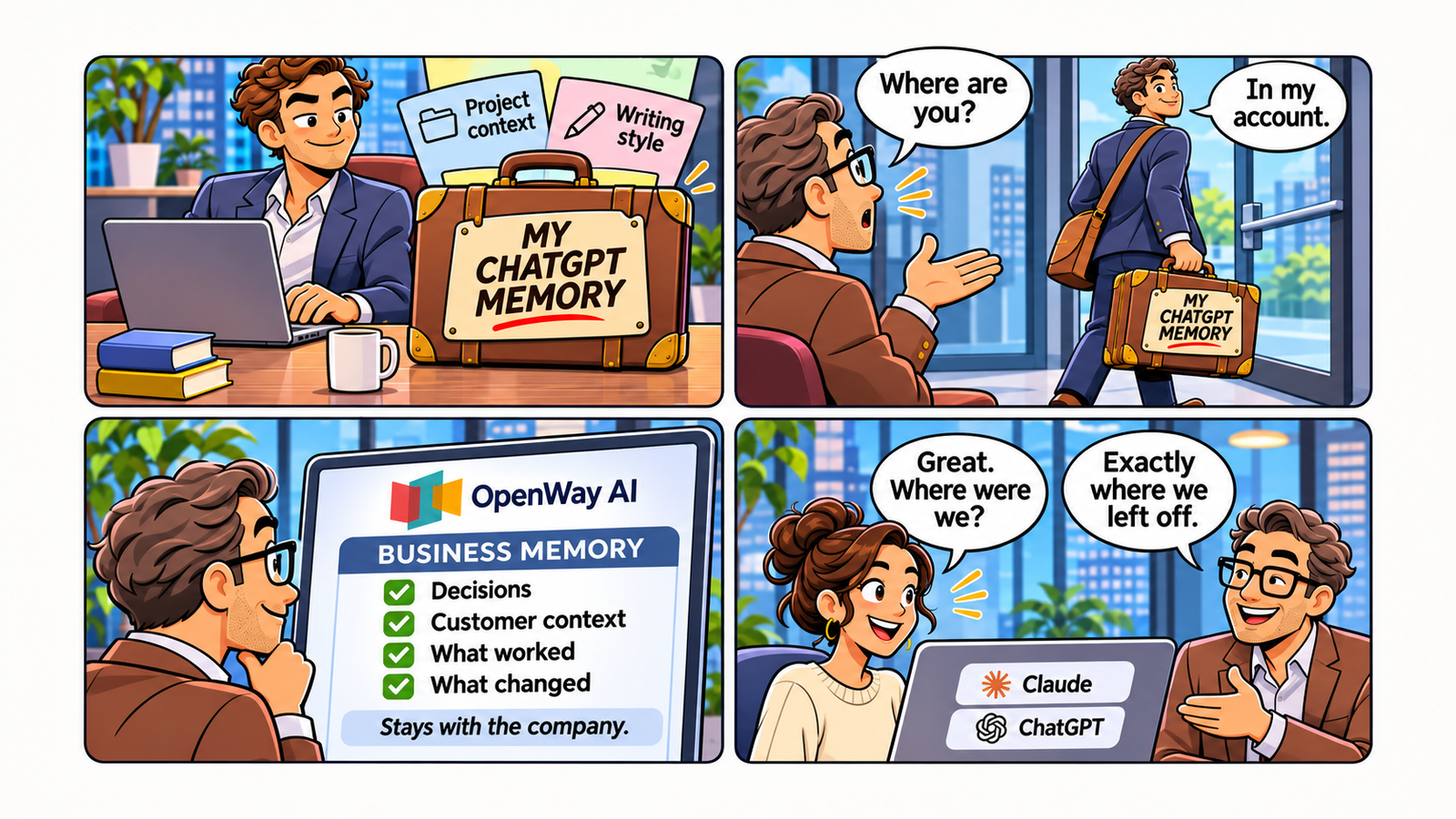
ChatGPT remembers things about you. It recalls your writing style, the projects you keep coming back to, the preferences you've stated once and never had to repeat. For a single person using a single account, that's genuinely useful.
The difference shows up at the team level. That personal memory is tied to the individual user. It does not automatically transfer to a teammate, and it does not become a shared company-wide memory just because the team uses the same ChatGPT workspace.
Business memory is built for a different layer. It's one shared memory for the whole team, usable inside Claude, ChatGPT and Slack, that holds the things that are actually about the business rather than about any one person using it.
What does ChatGPT's memory actually remember?
ChatGPT's memory is scoped to an individual account. Over time, it can use context from your conversations and other available sources to make future chats more useful: the tone you prefer, the fact that you run a B2B SaaS company, the project you keep asking about, or preferences you've mentioned before.
The next time you open a chat, that context can already be there, so you don't have to explain everything again.
On ChatGPT Business and Enterprise, admins can manage memory settings for the organization. But turning personal Memory on for ten seats does not create one company-wide memory that ten people draw from. Each user's personal Memory remains tied to that user's account.
ChatGPT also supports shared projects and shared project context, which can give multiple people access to the same project information. That is useful, but it is still project-scoped rather than one company memory that follows the business across ChatGPT, Claude and Slack.
If context about a customer exists only in one sales rep's personal Memory or private chats, the account executive who inherits that deal later does not automatically inherit it.
This isn't a flaw in ChatGPT's memory. It's doing the job it was built for: making one person's assistant feel continuous. It was never designed to serve as the company's shared memory across people and tools.
What is business memory, and how is it different?
Business memory is a company's own system of understanding: what it decided, why, and what happened next, so AI can work from current, trusted company knowledge and each result can inform the next decision.
It isn't tied to any one person's account. It belongs to the company, the same way a CRM or a shared drive belongs to the company rather than to whoever happens to be logged in.
In practice, that means context captured in the company's business memory can be available wherever the team works.
A positioning change captured in business memory can be available the next time someone asks Claude to draft a landing page. An objection from a sales conversation can be available when another rep opens ChatGPT to prepare a follow-up.
That's the practical shape of one business memory for your whole team, inside Claude, ChatGPT and Slack: the company context stays with the business rather than with one person's AI account.
The difference, side by side
| ChatGPT memory | Business memory | |
|---|---|---|
| Who it belongs to | The individual account holder | The company |
| What happens when someone leaves | Personal Memory does not automatically transfer to another employee | Company memory remains available to authorized team members |
| Where it works | ChatGPT | Claude, ChatGPT and Slack |
| What it holds | User-specific context from chats and other available sources | Company facts, decisions, positioning and outcomes |
| Scope | Individual user or shared project context | Company-wide shared memory |
| Who manages it | The user or organization admin, depending on the setting | The company, according to its access policies |
What happens when someone leaves the company?
This is where the difference becomes concrete.
Imagine a sales rep who has spent eighteen months learning which objections repeatedly stop deals, which existing customers make the best reference stories, and which phrasing tends to get a reply from a cold prospect.
Some of that knowledge lives in their head. Some may exist in their private ChatGPT conversations and personal Memory: drafts they refined, objections they pasted in, and context they built up over time.
If that information exists only there, it does not automatically transfer to the person who replaces them.
The replacement may have access to the CRM, documents, and previous account history, but the context accumulated inside the departing employee's personal AI workspace does not simply become theirs.
Business memory avoids that failure mode when the relevant information has been captured into the company's shared memory. The objection, the reference customer, or the reasoning behind a successful message can remain available to the next person working on the account.
The useful distinction is ownership. Personal AI memory follows the individual. Business memory stays with the company.
Can a sales team actually feel the difference?
The clearest version of this shows up in follow-up work, which is where a lot of revenue quietly gets lost.
One OpenWay AI customer reviewed 286 old opportunities and identified 72 with a concrete reason to revisit. Nineteen replied, seven returned to the active pipeline, and two eventually closed for $31,000 in annual contract value.
You can read the full breakdown in The $31,000 Sitting in Leads You Already Paid For.
The mechanism behind that case is closely related to business memory. The useful information isn't just that an old lead exists. It's why the opportunity stalled, what the company learned from the earlier conversation, and what has changed since then.
A personal memory can help the individual who built it. Business memory keeps that knowledge available to the company so the next action does not have to start from zero.
Do you have to choose one or the other?
No.
ChatGPT's own memory can keep doing the job it's good at: remembering how you personally like to work, what you're focused on, and the context that makes your own conversations more useful.
Business memory handles a different layer: the facts, decisions, and outcomes that are true about the company regardless of which employee is logged in.
Setting up business memory doesn't require turning ChatGPT's memory off, and using one does not prevent you from using the other.
Shared projects in ChatGPT can also be useful when a team needs common context around a particular project. Business memory is broader in scope: it is designed to preserve company knowledge across people, workflows, and multiple AI tools.
Which teams should care about this distinction?
Any team where handoffs, turnover, or simply having more than one person touch the same work is normal.
A sales team may hand an account from SDR to AE to Customer Success. A support issue may outlive the person who first opened it. A marketing campaign may be planned by one person and reviewed or repeated months later by someone else.
In each case, the cost of lost context is practical. Someone repeats a mistake, spends time reconstructing an old decision, or reopens a question the company had already answered.
The larger the gap between what individuals know and what the company can retain, the more visible that cost becomes.
FAQ
Does business memory replace ChatGPT's memory?
No. They operate at different levels. ChatGPT's personal Memory is tied to the individual user. Business memory is shared across the team and can work across ChatGPT, Claude and Slack.
Do I need to turn off ChatGPT's memory to use business memory?
No. The two can run independently. Setting up business memory does not require changing your personal ChatGPT Memory settings.
What about shared projects in ChatGPT?
Shared projects can give multiple people access to common project context inside ChatGPT. Business memory is broader: it is designed to maintain company-level context across people and across tools, including ChatGPT, Claude and Slack.
What happens to business memory if an employee with access leaves?
The memory stays with the company. Access can change when employees join or leave, but the company knowledge itself does not have to disappear with one person's account.
Is this the same as giving ChatGPT access to our company documents?
No. Giving ChatGPT access to documents or shared project context can provide reusable information inside ChatGPT. Business memory is meant to maintain a company-level record of current facts, decisions, and outcomes across the tools your team uses, including ChatGPT, Claude and Slack.
Want to see what shared business memory looks like with your own company context?
Share this article