AI Websites Look Finished Long Before They’re Ready
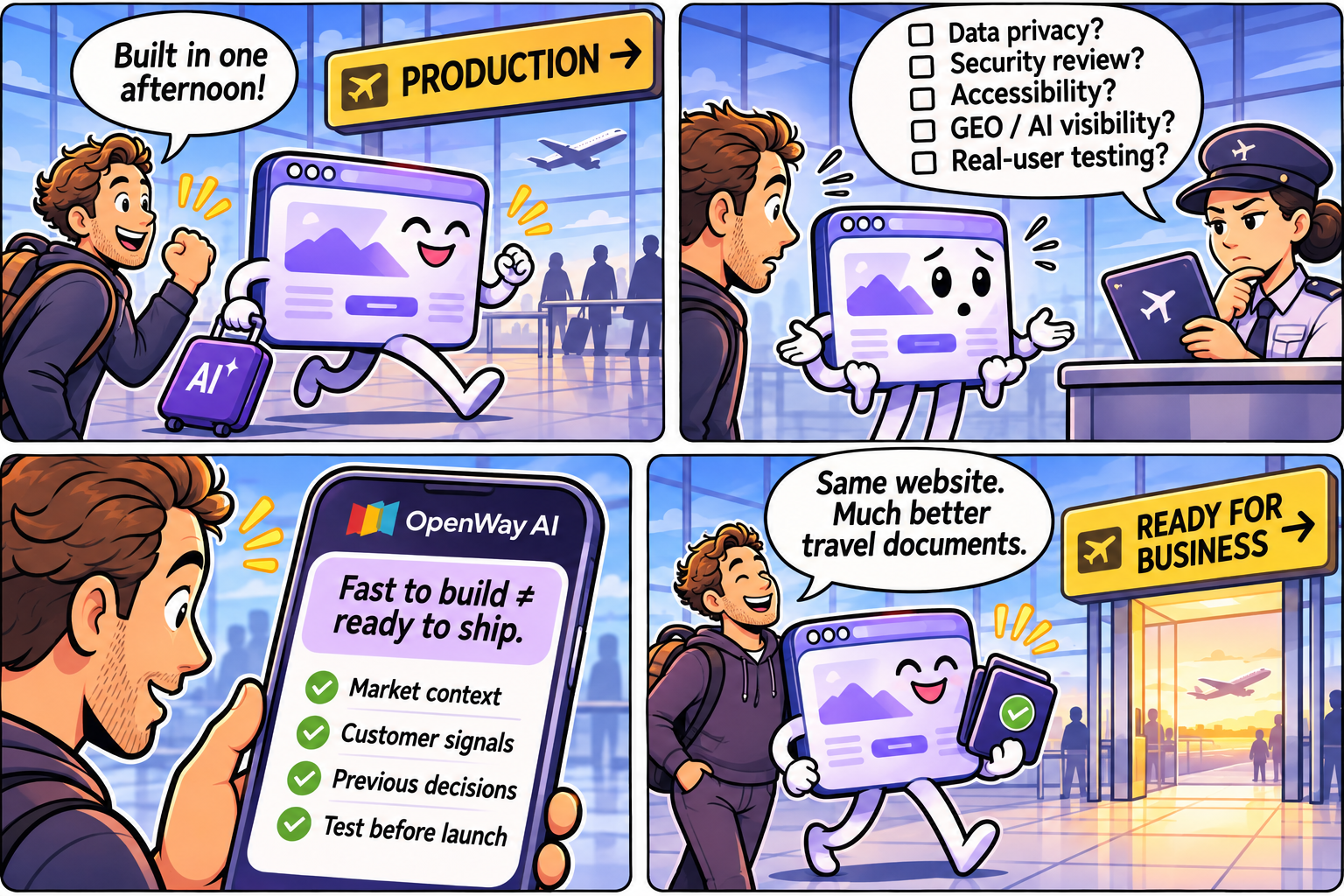
When Claude Code, Lovable, Replit, and other AI website-building tools started taking off, much of the conversation focused on whether designers and developers would still be needed. That question now feels a little beside the point.
AI has become genuinely good at getting a website surprisingly far, surprisingly fast. A founder can have a working landing page by the end of the day. A designer can turn an idea into an interactive prototype without waiting for engineering. A small team can test a product concept before committing to a full design and development cycle.
The upside is obvious. The less obvious consequence is that a website can now look finished long before it is ready to deal with real customers, real data, or real revenue.
We discussed this with a web designer and developer who works with international businesses. What she sees most often is not AI failing spectacularly. It is AI producing something convincing enough that people stop asking what still needs to be checked.
A polished frontend can hide a lot
A prototype used to announce itself as a prototype. Rough edges made its status obvious. Today, a few hours with an AI coding tool can produce navigation, forms, animations, responsive layouts, and a level of visual polish that looks very close to production.
That changes the way people judge readiness. Once an executive or founder sees something that looks complete, the remaining work can easily start to feel like developers being overly cautious.
Except much of that remaining work is exactly what separates a demo from a reliable website. Does the form always save what it should? What happens when a third-party service fails? Are permissions set correctly? Does the site behave properly with unexpected input? What data is being exposed? What happens when real users do things nobody included in the happy-path demo?
Research on vibe-coded applications suggests this is not just developer anxiety. A 2026 study found recurring issues including exposed secrets, unvalidated inputs, and placeholder logic. The researchers also pointed to broader weaknesses in the way agents work on long projects, including lost context, local optimization of the immediate task, and gaps in security knowledge.
Another recent benchmark found a similar pattern. AI coding agents were often able to satisfy the functional requirements of a task, but their security performance lagged well behind. Even the strongest system in that benchmark passed both the functional and security checks in only about a quarter of the tasks.
So a site opening correctly in the browser tells you much less than it used to.
AI has made the first 80% feel almost suspiciously cheap
For founders and growth teams, this may be the most important change.
Getting from an idea to something you can put in front of a customer has become dramatically cheaper. That is fantastic for prototypes, landing pages, market tests, and early product concepts. You can learn sooner and spend less before deciding whether an idea deserves serious investment.
Production is different. A live website may have to deal with customer accounts, CRM data, analytics, payments, permissions, integrations, third-party services, and the rest of the company's infrastructure. As the website gets closer to revenue, the cost of a failure goes up too.
That explains why teams sometimes feel confused by the last stage of an AI-built project. The first 80% appeared almost instantly, so why does the remaining 20% still require so much work?
Because AI has reduced the cost of producing a convincing demo faster than it has reduced the cost of making that demo dependable.
The savings are still substantial. But the amount of visible progress is no longer a very good proxy for the amount of work left.
A site can work for people and still be almost invisible to AI
One recent case involved a company in mental performance and sports nutrition coaching for athletes. Its website had been created with an AI app builder and looked complete to visitors.
There was one significant issue: the core content was rendered through JavaScript. People visiting in a normal browser saw the full page, while some AI crawlers received almost empty HTML.
After the site was moved to pre-rendered pages, the company reported better AI visibility and more inbound inquiries. Those performance results came from the agency that rebuilt the site, so they should be treated as vendor-reported data. The technical issue itself is more interesting: a website can appear completely normal to a person and still be poorly represented in the systems that increasingly influence product discovery.
For a growth team, that is not an obscure frontend detail. A redesign can improve the page visually while making the company harder to find through AI search.
The codebase does not contain the whole reason a website looks the way it does
AI agents are usually very good at the task in front of them. Ask one to simplify a form, change a page, add an analytics event, or rebuild a component, and it has a clearly defined problem to solve.
A business website carries much more baggage than that. It sits inside a CRM and analytics stack. It has privacy and security requirements. It may need to behave differently across countries. There are accessibility rules, brand decisions, SEO and GEO considerations, integrations, customer objections, and choices that were made months ago for reasons nobody wrote into the code.
This distinction between technical context and business context matters more as companies let AI make larger changes.
Technical context tells the agent how the website works. Business context explains why the company chose to make it work that way.
Without the second one, AI can make a perfectly competent change that quietly reverses a good business decision.
Imagine a team added a fairly detailed implementation section to its homepage after the same concern kept coming up in sales calls. The section worked. Prospects understood the issue better, and conversion improved.
A few months later, someone asks an AI agent to make the homepage cleaner and more concise. Looking only at the page, that long section is an obvious target. Removing half of it may even make the design better.
Nothing breaks. The code is fine. The page looks more elegant. The company has still managed to remove something that was there for a proven reason.
This is one reason we care so much about business memory at OpenWay AI. If AI is going to work on business assets repeatedly, it helps to retain more than the latest version of the asset. Customer findings, previous hypotheses, tests, and the reasoning behind earlier changes can matter just as much as the page currently sitting in production.
Some of the most important requirements are invisible
Our expert raised another problem that tends to show up when someone moves from a managed website platform to generating their own code with AI: the platform used to handle things they never realized they needed to think about.
Legal requirements are an obvious example. A website can be technically functional while its privacy setup, cookie behavior, accessibility, consent flows, data handling, or disclosures are wrong for the market where the business operates.
The same site may need different treatment depending on whether the company is selling in the US, serving users in the EU, working in a regulated industry, or collecting a particular type of customer data. AI cannot be expected to infer all of that reliably from a generic request to "build a website."
Security has the same problem. An exposed secret in client-side code does not make the homepage look broken. Neither does loose authentication, an unnecessary third-party script, a bad permission setup, or missing security headers.
Experienced developers tend to think of these things as routine hygiene. Someone who has just discovered that they can generate a polished website in an afternoon may not know that the checklist exists.
That is why the quality of an AI website workflow increasingly depends on the context supplied around the task, not just on the quality of the prompt used to generate the page.
AI websites can look different without being very different
There is another issue, this time on the marketing side.
Generative tools can produce enormous visual variety. Change the prompt and you can get different colors, typography, illustrations, layouts, and stylistic details almost indefinitely. Yet underneath that surface variation, the strategic choices often converge.
One experiment compared 17 independently generated homepages for the same company. They looked quite different at first glance, but once researchers examined their underlying structures and strategies, the pages clustered into roughly five main creative families. Cosmetic variation scored 4 out of 5; strategic and structural variation scored only 2 out of 5.
That lines up with what our expert has been seeing in client work. The tell is no longer necessarily "bad AI design." Plenty of AI-generated design looks good. The more interesting tell is a certain sameness in the assumptions underneath it.
Rounded cards and gradients are not the issue. Great designers use both. The question is whether the site arrived at a distinctive way to explain this particular company, or whether it produced a polished version of the most statistically likely SaaS homepage.
As execution becomes cheaper, that distinction becomes more important. If every competitor can produce attractive pages quickly, the advantage moves elsewhere: positioning, customer evidence, market understanding, and the accumulated knowledge behind the decisions on the page.
Designers and developers are not disappearing. Their job is moving.
AI is already taking a meaningful amount of production work off specialists, and that is useful. A product designer can build a functioning prototype instead of stopping at static screens. Developers can delegate repetitive implementation. Founders and growth teams can test ideas before asking a full product team to build them.
The valuable part of professional work is moving toward decisions that are harder to automate: architecture, risk, constraints, review, and knowing when something that looks finished is not ready to ship.
We have already seen something similar with image generation. Making an attractive image became much easier. Building a distinctive visual identity did not.
Websites are moving in the same direction.
The better question is no longer whether AI can build the site
For most ordinary business websites, that debate is already outdated. AI can build a lot.
The questions worth asking are more practical. What does the AI not know about the business that could affect this page? Which parts look production-ready but have not actually been reviewed at that level? What has the company already learned from customers and previous experiments that the next iteration should preserve?
A team with good answers to those questions can get enormous leverage from AI. A team without them can also move very fast, just potentially in the wrong direction.
That, more than whether a human or an agent typed the code, is becoming the useful distinction between vibe coding and AI that is genuinely part of a business workflow.
How OpenWay AI approaches website creation
This is also why creating a page in OpenWay AI is not limited to describing what the finished page should look like. The system can work from existing business context, research the market and competitors, use customer signals and previous decisions, and then build the structure, design, images, and landing page. If the company already knows that a certain message works, that one segment matters more than another, or that a particular section was added for a specific reason, that history can remain part of the next iteration.
The page can then be tested with real traffic. Different versions can be compared, the result can inform the next change, and the process does not have to reset every time the page is edited. This is part of the same growth cycle OpenWay AI uses across the customer journey. The goal is still to make website creation much faster, but without separating the page from what the business already knows or from what happens after it goes live. Publishing and other external actions remain under the team's control.
Get $25 in credits to try it.
Share this article