Growth Is a Cycle, Not a Funnel: How OpenWay AI Works Across the Entire Customer Journey
There are already thousands of tools on the market that promise to help businesses grow.
Some find leads. Others enrich contacts. Others launch email sequences. Some help build landing pages. Some manage CRM. Others automate individual parts of sales.
The market feels crowded. And it is.
According to chiefmartec, there were around 150 products on the marketing technology landscape in 2011. In 2026, there are more than 15,000. But if you look closely at where these tools are concentrated, an important shift becomes clear.
Most growth tools operate where automation is easiest: finding a contact, enriching a database, sending the first message, and getting someone to fill out a form or book a call.
That is an important part of growth, but it only describes the beginning of the customer relationship.
After that comes a more complex zone. You need to do more than reach someone. You need to explain the value of the product, answer doubts, move the conversation toward a deal, help the new customer understand the product, suggest the next step at the right time, bring back those who left, and understand which customers actually stay for the long term.
At that point, public data and template-based automation are no longer enough. The system needs to know the business itself: the product, the real promises, the customers, past conversations, deals, campaigns, constraints, and how the company actually works.
That is why OpenWay AI is built around the idea of Full-Cycle Growth.
There is no separate screen in the product with that name. It is not a module or a button. Full-Cycle Growth is how we describe the fact that OpenWay AI works not with one piece of growth, but with the entire customer journey: from research and early hypotheses to acquisition, the deal, onboarding, retention, upsell, and the next cycle of growth.
Why the traditional funnel no longer describes growth
Many companies still think about growth as a funnel.
First, they attract traffic. Then they get a lead. Then they move that lead toward a deal. Then they close.
But real business does not work that way.
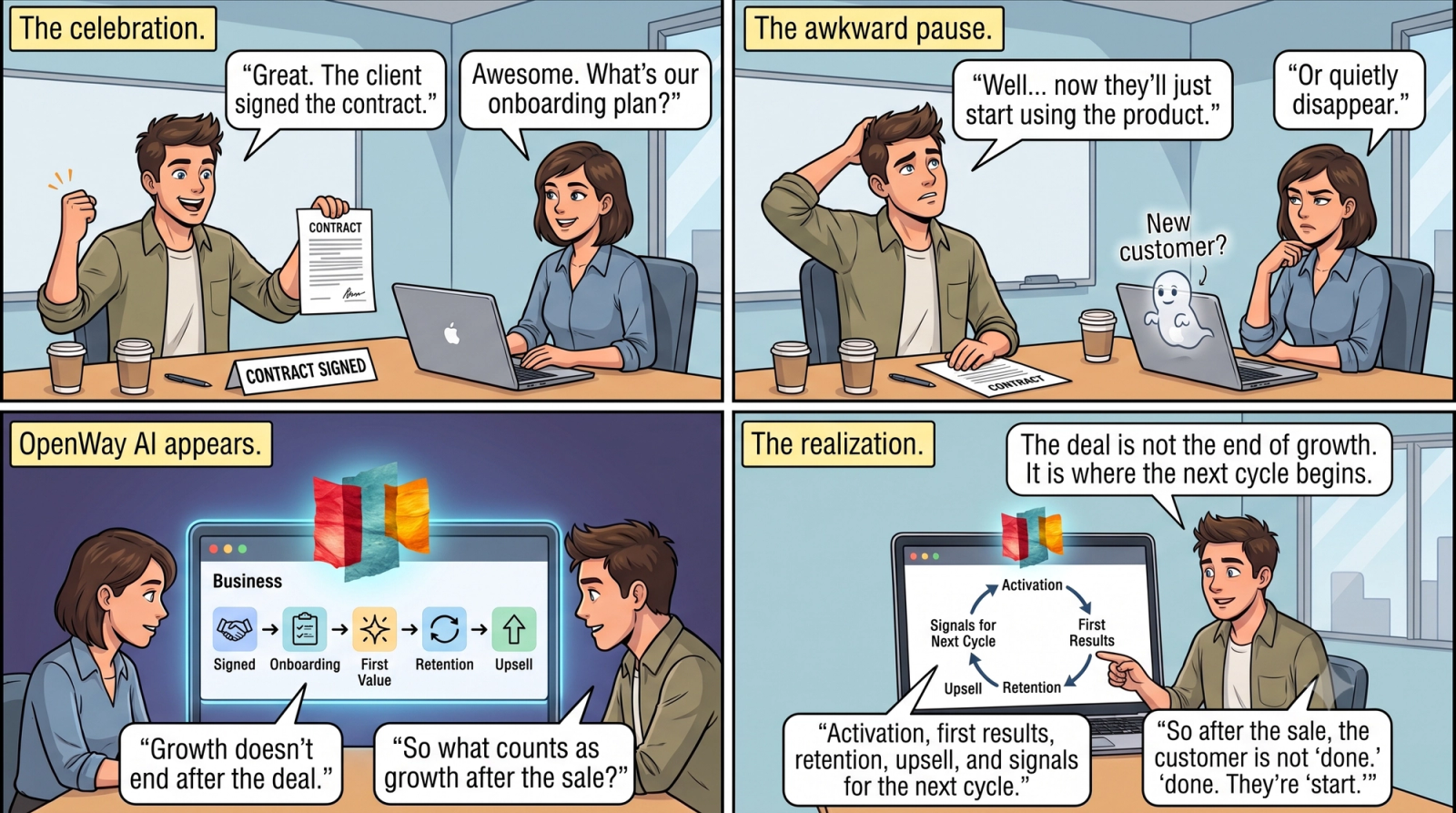
The customer’s life does not end at the moment of purchase. In fact, after the deal, a stage begins that is often more important than the first touchpoint. The customer uses the product, asks questions, runs into barriers, gives feedback, renews, expands usage, recommends you to others, or leaves.
All of this is not “after marketing.” It is the material for the next round of marketing.
Why did the customer stay? Why did they leave? What did they only understand after onboarding? Which page convinced them before the purchase? Which promise mattered most? What should change in the landing page, email, sales deck, or offer?
If these signals do not return to the system, you start almost from scratch every time.
That is why growth is better described not as a funnel, but as a cycle.
Research creates a hypothesis - The hypothesis becomes a page, campaign, or email - The page brings in leads - Leads become conversations - Conversations become deals - Deals become customer experience - Customer experience returns as new hypotheses.
This is how each new launch becomes smarter than the previous one.
Growth only begins after the deal
The biggest mistake in growth thinking is treating the deal as the finish line.
In reality, a new part of the customer journey begins after payment. The customer enters the product for the first time, figures out the setup, asks questions, faces barriers, gets their first result or does not, comes back to you for support, expands usage, buys more, recommends you to others, or gradually disappears.
All of this is growth too. Onboarding affects activation. Product emails help customers see value faster. Customer support and guidance reduce churn risk. Upsell and expansion appear when the customer has already understood the value. Win-back helps bring back customers who left but may still be interested.
The problem is that for many growing companies, this part of the journey exists, but it is not organized into a system. There is CRM somewhere, billing somewhere else, emails in another tool, manager notes, support conversations, and the landing page that originally brought the customer in. But these signals rarely work together.
As a result, a company may attract new leads without seeing which customers actually stay. It may launch new campaigns without using the questions that repeat during onboarding. It may lose customers without turning the reasons for churn into new hypotheses for the product, website, or communication.
Full-Cycle Growth exists for exactly this reason: so growth does not stop at the deal, but continues through product education, retention, repeated touchpoints, upsell, and the next cycle of experiments.
Where the usual growth stack breaks
The problem is not that companies lack tools.
More often, the problem is that there are too many tools, and the shared context between them does not exist.
One service helps build a contact list. Another sends emails. A third stores deals. A fourth creates landing pages. A fifth shows analytics. A sixth stores meeting recordings.
On paper, everything is covered. In practice, gaps appear between these tools. A lead fills out a form, but is not connected to the right campaign. The sales team hears an important objection, but it never reaches the website. A customer becomes a paying customer, but keeps receiving cold emails. An A/B test shows a winner, but the result is never used in the next page. A meeting happens, but the follow-up is written from scratch again. Customer success notices a reason for churn, but marketing never hears about it. Someone has to close each of these gaps manually.
Usually, that “someone” is the founder, marketer, or operations person on the team. They move context from CRM into an email, from a meeting into a landing page, from analytics into a hypothesis, from a test result into the next launch.
In other words, the company buys tools to accelerate growth, but still leaves a human as the courier between them.
OpenWay AI solves this differently: one system, one Business Memory Factory, and one cycle where each stage passes knowledge to the next.
The five stages of Full-Cycle Growth
At OpenWay AI, we describe the full growth cycle through five stages:
Research - understand the business, market, and hypotheses.
Attract - create pages, campaigns, and first entry points.
Convert - turn interest into leads and conversations.
Close - help move deals toward a decision.
Retain - support the customer after purchase: onboarding, product education, upsell, win-back, retention, and returning these signals into the next growth cycle.
Important: these are not five separate products inside one interface.
The point is not that OpenWay AI “has many features.” The point is that these features are connected through one shared business memory.
The connection between stages is what creates value.
Research: start without a blank page
Many tools start with a form: tell us who you are, what you sell, who you sell to, who your competitors are, and what makes you different.
OpenWay AI starts differently.
From day one, the system studies your website, builds a basic understanding of the business, suggests a Business Profile, and helps define products, audiences, competitors, pricing, positioning, and possible growth directions.
The user does not need to manually fill out a huge questionnaire. They review, clarify, and confirm.
That is a fundamental difference.
OpenWay AI does not wait until you perfectly explain the business. It helps create the first working picture that can then be used for pages, emails, campaigns, pitch decks, analysis, and experiments.
In this logic, Research is not a standalone report for the sake of a report. It is the foundation for the next actions.
Attract: do more than create a page, launch a hypothesis
When a company asks OpenWay AI to create a landing page, the task is not simply to generate a good-looking template.
Before that happens, the system already understands the business: the product, market, audience, competitors, positioning, previous materials, and possible growth angles.
That means the page becomes more than an asset. It becomes a hypothesis.
For example: this segment responds better to speed of launch. Or: this audience cares more about reducing operational workload. Or: in this market, the page needs to show the difference from alternatives more clearly.
OpenWay AI can create a landing page or website, prepare a marketing email, help with an ad campaign, suggest page improvements, and connect all of this to what was found during the Research stage.
But the more important part is this: once published, the page does not live separately. It is connected to the next stage. Forms work, visitor actions are tracked, submissions become contacts, and data returns to the system.
The page stops being a “publication.” It becomes part of the growth loop.
Convert: every lead should become understandable, not get lost
Between “someone submitted a form” and “we have a real sales opportunity,” there is usually a lot of manual work.
You need to understand who the person is. What company they work for. Why they may be interested. What to write to them. When to follow up. When to stop. When to hand the conversation to a human.
OpenWay AI helps close this part of the cycle.
When a form is submitted on a page, the contact appears in the system. For campaigns, OpenWay AI can research the company, prepare an email in your style, suggest a follow-up, classify replies, and show where a human is needed.
At the same time, external actions remain under the user’s control. Anything that sends, spends, or publishes goes through sign-off. This is an important part of the product: OpenWay AI should speed up the work, but not take control where there is risk to money, reputation, or customer relationships.
The principle is simple: the system prepares, you approve.
Close: sales should not begin by rebuilding context
The hardest part of growth starts when the conversation becomes real.
At this stage, it is no longer enough to know a name, company, and job title. You need to understand what matters to the customer, what doubts they have, which arguments have already been discussed, what you can promise, which materials to send, and where the deal is stuck.
This is why many simple automation tools end too early. They help start the conversation, but do not help move it toward a decision.
OpenWay AI works with this zone through meetings, deals, notes, follow-ups, proposals, and documents.
If a company has connected a CRM, OpenWay AI can see deals as a read-only mirror. This means it understands what is happening, but does not replace the CRM or edit it on behalf of the team. It can help answer questions like “which deals have gone quiet?” or “where do we need a follow-up?”, while your CRM remains the system of record.
After a meeting, the recording becomes text, important themes and action items become available, and a follow-up can be prepared faster. A pitch deck, proposal, or one-pager can be created not from a template, but from the context of the specific business and the specific situation.
At this stage, OpenWay AI helps with more than “writing a document.” It helps preserve the meaning of the conversation.
Retain: growth does not end after payment
The most underrated part of growth is what happens after the first payment.
The customer starts using the product. They go through onboarding, explore features, ask questions, get their first result, ask for support, renew the subscription, buy more, recommend you to others, or leave.
For large companies, this is the world of customer success. They have dedicated teams, processes, playbooks, platforms, and analytics.
But many growing businesses do not have that team. That is why the post-sale stage often remains almost empty: the customer has bought, but there is no system to guide them further.
OpenWay AI helps close part of that gap.
If billing data is connected, the system can see basic customer statuses: who is active, who has a payment problem, and who has churned. Paying customers do not need to be included in cold campaigns again. Churned customers can be used as the basis for a win-back campaign if the team decides to launch one.
But Retain is not only about “retention at any cost.”
It is also about working with people who have already become customers: helping them understand the product faster, sending a useful onboarding campaign, explaining the next opportunities, offering a relevant upsell, collecting feedback, and understanding what prevents the customer from moving forward.
Through campaigns, OpenWay AI can help build these touchpoints not as a mass email “for everyone,” but as communication based on business context, the customer segment, and what is already known about their journey.
This is not a replacement for a full customer success team. And it is important to be honest: OpenWay AI does not “retain all customers by itself.”
But it does something that often does not happen at all: it connects post-sale signals back to growth.
- Who stayed?
- Who left?
- Who is ready for the next offer?
- Which page brought in a paying customer?
- Which segment retains better?
- Which questions repeat during onboarding?
- Which customers can be brought back through a win-back campaign?
- What should be used in the next hypothesis?
This is how Retain becomes Research again. The cycle closes.
Why hand-offs matter more than individual features
If you bring together five good tools for five stages, do you get Full-Cycle Growth?
Not necessarily.
You can have a strong landing page tool, a separate email platform, a CRM, analytics, and a customer success platform. But if each one lives in its own memory, the gaps remain.
The main value of OpenWay AI is not that it “creates landing pages” or “writes emails.”
The main value is in the hand-offs.
- What is found in Research is used in Attract.
- What happens on the page becomes a signal for Convert.
- What is heard in a sales call can return to messaging.
- What happens after purchase becomes the basis for the next hypothesis.
- What worked in an experiment does not disappear inside one tool.
Point tools optimize a stage. A full-cycle system connects the stages. That is where compounding begins. Each new cycle makes the next one more precise.
The system proposes, the human decides
When a product works across the full growth cycle, control becomes critical.
OpenWay AI should not unexpectedly spend budget, send an email, publish a page, or change an important asset without confirmation.
That is why the product principle is: nothing that spends, sends, or ships happens without your sign-off.
If OpenWay AI prepares an ad campaign, the user sees an approval card and the budget before launch. If emails are prepared, they wait for approval. If a page needs to be published or a test result should become the main version, that also goes through user control.
At the same time, low-risk internal work can happen on its own: analysis, preparation, classification, transcription, suggestions, weekly reports, and signal detection.
This is not a “fully autonomous AI” living a life of its own.
It is a system that can do much of the heavy work, while leaving the human the right to make decisions where there is an external effect.
A growth loop that gets smarter
A good growth system should not only launch activity. It should learn.
OpenWay AI can help with A/B testing for pages: create a variant, split traffic, show the result, and assess whether the new version is truly better than the old one. It can suggest the next step: which page should be tested, where a different message is needed, and which channel is showing a signal.
Not every step should be automatic. On the contrary, important changes go to approvals. But the logic changes: the business no longer needs to manually collect all the pieces every time to understand what to do next.
The system sees more connections. It remembers why a page was created. Which hypothesis was behind it. Who came in. What they did. What conversation started. How the deal ended. What happened after the purchase.
This is growth as a cycle, not as a set of disconnected tasks.
What this can look like for a user
Imagine a normal workweek.
On Monday, you connect your website and main sources. OpenWay AI studies the business and suggests a Business Profile. You confirm the main points and correct the inaccuracies.
On Tuesday, you ask it to create a landing page for a new segment. The system uses business context, the market, competitors, and positioning instead of starting from a blank template.
On Wednesday, a submission comes in through the page. The contact enters the system, and OpenWay AI helps understand who it is and what kind of conversation should start.
On Thursday, a sales call takes place. The recording becomes a transcript, action items appear, and the follow-up is prepared.
On Friday, you see that one message works better than another. This becomes not just a note in your head, but new knowledge for the next test.
A month later, you understand which customers do more than arrive. You understand which ones stay. And that changes the next cycle: which segment to choose, which offer to strengthen, which landing page to rewrite, and which campaign to launch.
Growth stops being a set of heroic manual actions.
It becomes a learning system.
The takeaway
The market is crowded with tools that help start a conversation with a potential customer.
But growth does not end with the first email, the first click, or the first form submission.
Real growth becomes a system when a business can move through the full cycle: research the market, attract the right people, turn interest into conversations, move deals toward a decision, see what happens after purchase, and return that knowledge into the next cycle.
That is what we call Full-Cycle Growth.
OpenWay AI was not built to replace one tool with another. It was built to remove the gaps between the stages of growth.
Because the most valuable knowledge often appears not before the sale, but after it.
And if that knowledge does not return to the system, the business starts from zero again and again.
Want to turn every stage of the customer journey into your next growth signal?