AI Marketing for B2B: What Drives Growth
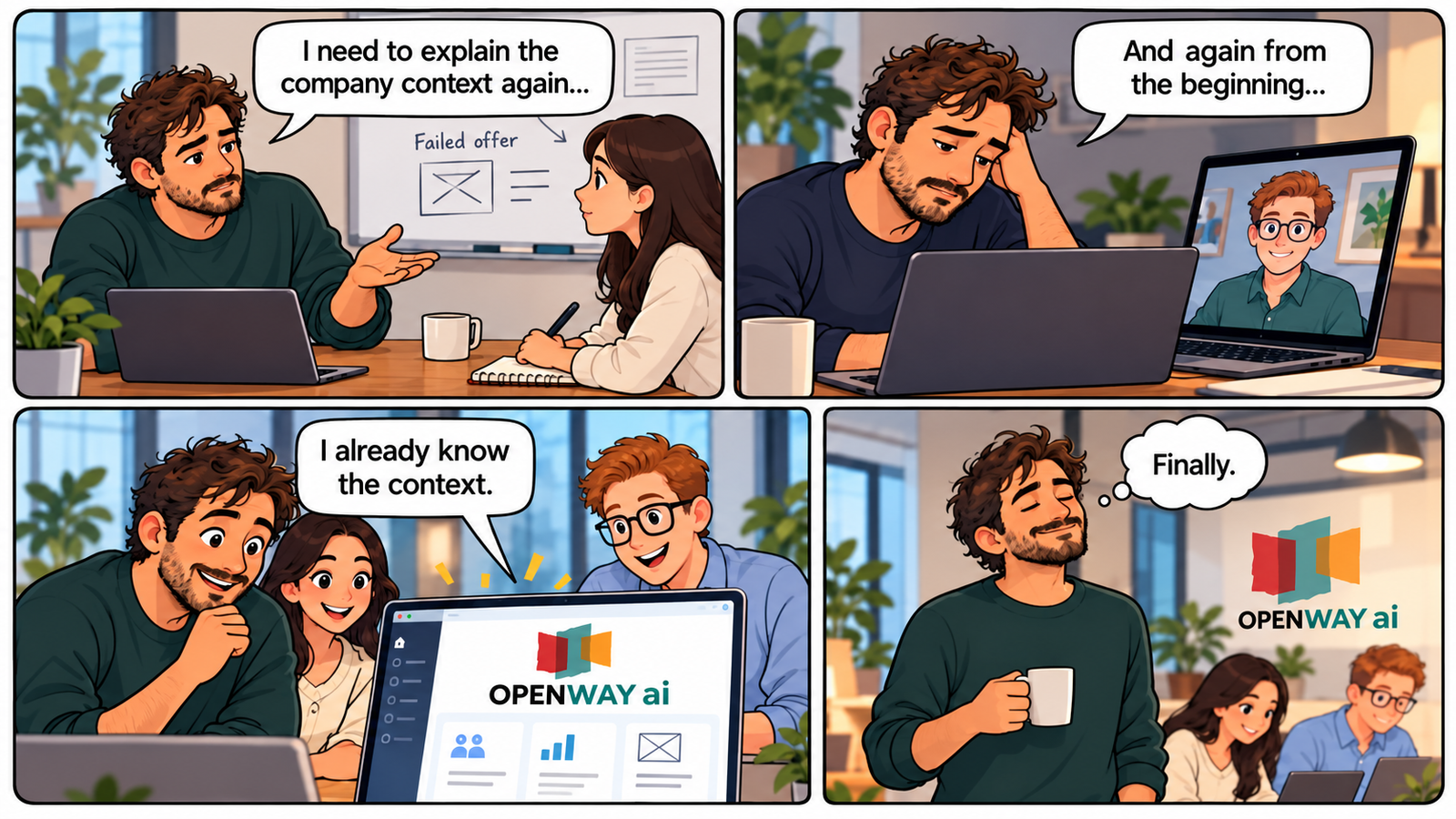
The easiest part of B2B marketing to automate is content production. AI can already write emails, ads, posts, landing pages, and reports quickly, which means speed of production alone is becoming less of an advantage. The harder job is deciding what deserves to be created, which customer evidence supports the idea, how to test it, and what the business should remember afterward. That is where B2B AI marketing becomes more useful than content generation.
OpenWay AI is the growth layer that runs on your company’s own operating memory. It builds and publishes pages, launches campaigns, and tests demand from what your business already knows.
What is AI actually useful for in B2B marketing?
Marketing ideas in B2B rarely come from marketing alone. A useful signal might appear in a sales call, a lost deal, a support conversation, the behavior of a particular customer segment, or the results of an old campaign. AI is especially useful when it can bring those scattered signals together and help a team see patterns that are difficult to spot manually.
Suppose several prospects independently say that implementation looks difficult. That observation alone is not a reason to rewrite the website. But if CRM history also shows that opportunities mentioning implementation are more likely to stall, the company now has a real marketing hypothesis: perhaps the implementation process needs to be explained more clearly, and perhaps that explanation should be tested.
AI can then help turn the hypothesis into a landing page, advertising campaign, email sequence, or another experiment. The useful work does not end when the asset is created. Once the market responds, the company needs to understand what happened and preserve the conclusion so the same idea is not rediscovered six months later.
A practical AI marketing system therefore connects four things: a market signal, a hypothesis, an action, and a result. Most companies already use AI heavily for the action. The larger opportunity lies in connecting all four.
Where should a B2B team start?
Start where uncertainty is already costing the company money.
If acquisition spend is rising while pipeline remains weak, investigate lead quality before producing another batch of ads. If prospects regularly stall late in the sales process, look at sales conversations before launching the next campaign. If the company is considering a new market or product feature, use the evidence it already has to test demand before committing a larger budget.
The same principle applies to an underperforming landing page. Instead of asking AI to “make the copy convert better,” compare what the page says with the language real buyers use in calls and emails. The problem may be the copy, but it may also be the underlying offer, the audience, or an objection the page never addresses.
There is an important difference between asking, “Give me ten campaign ideas,” and asking, “Why do mid-market prospects reach the demo stage and then stop moving forward?” The first question produces content. The second starts an investigation. In B2B, the second type of task is usually much more valuable.
Can AI find marketing opportunities in sales calls?
Yes, and this is one of the most practical B2B use cases.
In one OpenWay AI case, a company had 126 sales calls from the previous three months. An implementation concern appeared explicitly in 21 calls, and eight of those opportunities later slowed down or went cold.
At the same time, the company already had evidence that could answer the objection. Several similar customers had successfully implemented the product without dedicated implementation teams. The business knew both sides of the story, but the objection and the answer lived in different places.
Once those pieces were connected, the insight was used to change website messaging, the FAQ, and follow-up materials.
This is where the difference between useful AI and simple automation becomes clear. Summarizing 126 calls is relatively easy. The harder and more valuable job is deciding what those conversations should change in marketing.
How does business memory change marketing?
Business memory is a company’s own system of understanding: what it decided, why, and what happened next, so AI runs growth on current, trusted knowledge and every result sharpens the next decision.
Learn more about business memory
For marketing teams, this means an experiment should not end as a chart in an analytics dashboard. The company should retain the hypothesis, the evidence behind it, the audience, the action it took, the result, and the conclusion that should influence future work.
This becomes particularly important when teams change. A new marketer should not need six months to rediscover which positioning ideas were already tested, why the company stopped targeting a particular segment, which objection sales has been hearing for a year, or why a channel stopped performing. The raw data may still exist somewhere, but the logic behind the decisions is often much harder to recover.
Business memory is designed to preserve that logic, not just the underlying facts.
Where does marketing end?
For a B2B company, the lead is often too early a point to declare the marketing job complete. A campaign can have an excellent conversion rate while producing weak pipeline. Sales may discover that an offer attracts the wrong buyers. Customer success may later find that the original acquisition message created expectations the product could not meet.
Those are marketing signals too, and they need to travel back into the system.
OpenWay AI uses Full-Cycle Growth: Research, Attract, Convert, Close, Retain. The point is not to invent another version of the traditional funnel. The important difference is that information can move backward as well as forward. What the company learns during Close can change Attract. What happens during Retain can change Convert. A pattern in customer conversations can trigger new Research.
Read more: Growth Is a Cycle, Not a Funnel
How do you know whether AI marketing is working?
One of the least useful ways to measure AI adoption is by counting how much content it produces. Ten new landing pages are not better than one if the company does not know why they were created or what changed as a result.
Measure the hypothesis instead. If the problem is lead quality, track qualified opportunities rather than form fills alone. If you are trying to address a recurring objection, look at what happens to the affected deals and whether the objection continues to appear. If you are testing a new market, define the result that would justify further investment before the experiment begins. If you change a landing page, decide which user behavior should change.
This approach makes negative results valuable too. A test that quickly shows an idea does not work may save far more money than a campaign that produces a modest conversion lift. The important part is that the conclusion remains available to the business and changes what happens next.
That is what memory compounds means: every customer conversation, campaign, and test should make the next growth decision better informed than the last.
What should marketers still control?
AI can take on a substantial share of research, analysis, production, and execution. Strategy, positioning, product claims, budgets, and external communication still require accountable human judgment.
OpenWay AI can use company context to prepare pages, campaigns, and growth tests.
You approve anything that leaves the building.
That principle becomes more important as AI systems move from generating recommendations to taking real actions.
OpenWay AI is the growth layer that runs on your business memory.
FAQ
What is B2B AI marketing?
B2B AI marketing is the use of AI across customer research, positioning, campaign creation, conversion, sales feedback, and marketing analysis. It creates the most value when AI work is connected to pipeline and business outcomes rather than measured only by the amount of content produced.
Where should a B2B company start using AI?
Start with a specific growth problem where the business already has evidence. Good examples include recurring customer objections, poor lead quality, an underperforming landing page, stalled opportunities, or a hypothesis about a new market. The more specific the question, the more useful the available business context becomes.
Can AI replace a B2B marketing team?
AI can perform a substantial share of research, analysis, production, and technical execution. Businesses still need human judgment around strategy, positioning, priorities, brand, customer understanding, and which actions are worth taking.
How is AI marketing different from marketing automation?
Traditional marketing automation primarily follows predefined workflows and rules. AI can interpret unstructured information, identify patterns, form hypotheses, and create new work based on context. In practice, the two increasingly work together.
Why does business memory matter for marketing?
Marketing teams should not have to rediscover what the company already learned. Business memory preserves not only data and results, but also decisions, hypotheses, and conclusions, so the next growth task can start from accumulated knowledge.
Start free with one real task
Bring one real B2B growth problem where your company already has evidence.
Share this article