Which B2B Growth Channel Can Drive Your Next $1M Without Doubling Your Team?
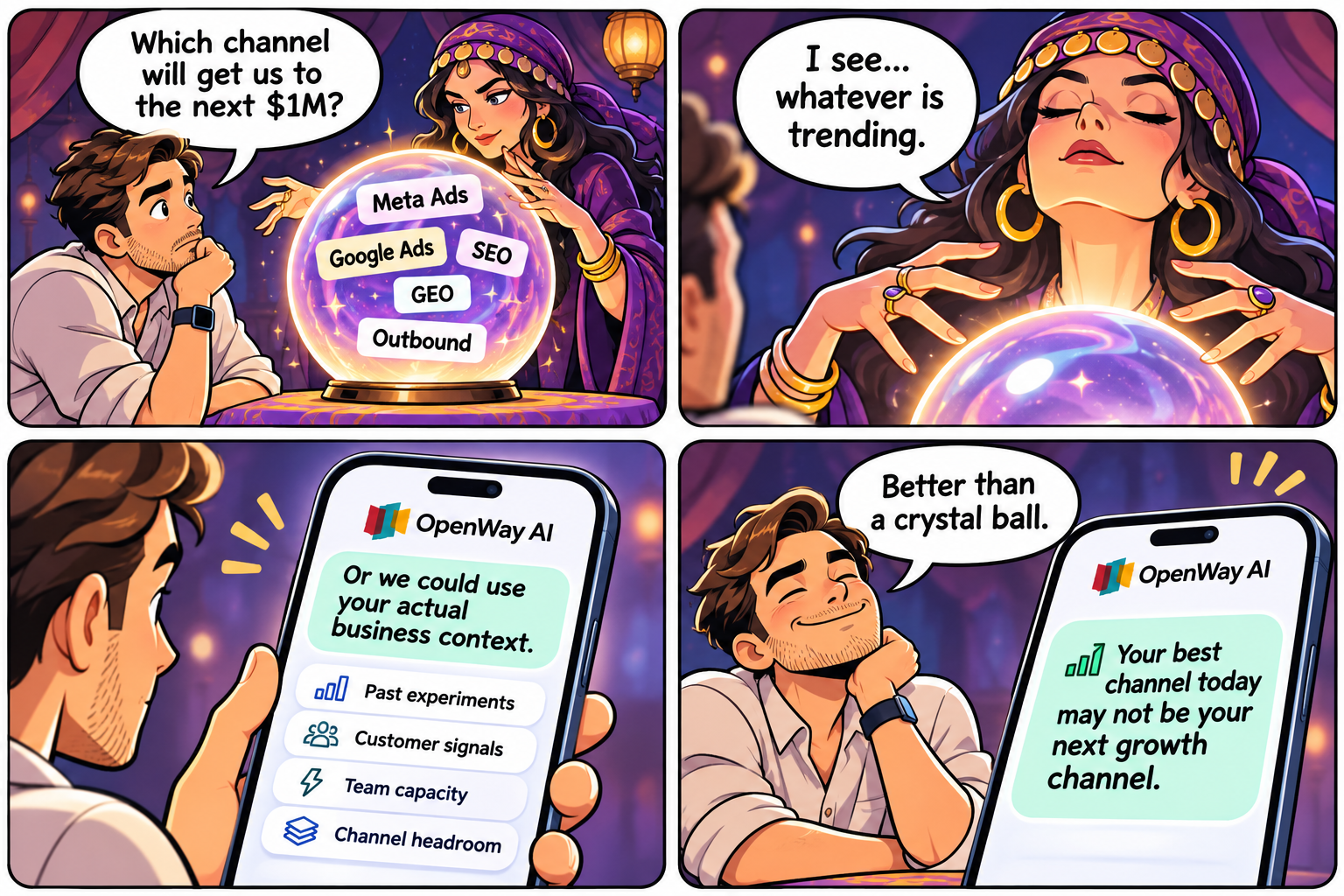
The B2B growth channel most likely to drive your next $1 million is the one with enough room to scale without destroying its economics or overloading your team. That requires looking beyond current CAC or conversion rates and asking what happens to demand, customer quality, and operational load when the channel gets materially bigger.
It also means using what the company has already learned about its customers, segments, messaging, and previous experiments. OpenWay AI works on exactly this connection between past experience and the next growth decision. OpenWay AI is the growth layer that runs on your company's own operating memory. Accumulated business context can help shape the next hypothesis, support the experiment, and preserve the result for the decision that follows.
This article is part of OpenWay AI's 100 Questions for Business Growth series, where we look at practical questions that emerge as a company moves into its next stage of growth. In an earlier article, we explored why word of mouth stops bringing in new customers at a certain stage.
Why might your best channel today fail to drive the next stage of growth?
Historical performance tells you what has already happened. A scaling decision depends on what happens next.
Suppose a company spends $20,000 a month on Google Ads and gets a reliable pipeline. That does not mean $40,000 will produce twice the result. The strongest search demand may already be captured, so the next layer of growth requires broader keywords, new use cases, or buyers with weaker purchase intent.
Outbound follows the same pattern. Teams usually start with accounts that fit the ICP most closely. As volume increases, they move into less obvious accounts. Activity can keep rising while the quality of the next audience layer declines.
SEO has its own version of this problem. Early topics are often close to the product and commercial demand. Later growth increasingly comes from broader informational queries, where more traffic does not necessarily create a comparable increase in pipeline.
In 2026, content has another job as well. Buyers increasingly research products through ChatGPT, Claude, Google AI Overviews, and other AI-search interfaces. That means content strategy now has to account for GEO, or generative engine optimization, alongside traditional SEO.
How do you optimize content for GEO?
Start with the questions real buyers ask, not with an attempt to write a special kind of copy "for AI."
Useful GEO content gives direct answers, uses product and category names consistently, supports important claims with facts and sources, creates clear relationships between related pages and concepts, and stays current. For B2B companies, practical use cases and evidence are particularly valuable because generic advice gives both buyers and AI systems very little reason to associate a company with a specific business problem.
This changes how the content channel should be measured too. Organic visits and form submissions show only part of its value. SEO and GEO increasingly work as a shared discovery layer, helping buyers find a company, understand its category, and consider the product before their first direct visit to the website.
A strong growth channel therefore needs more than good performance at today's volume. It needs room for the next stage.
How much growth is actually left inside a channel?
A useful concept here is channel headroom: how far a channel can scale before market, economic, or operational constraints start materially reducing its value.
For Google Ads, headroom is closely related to available search demand. In a narrow B2B market, only so many companies are actively searching for a particular solution at any given time. Once the strongest demand has been captured, additional budget has to reach broader queries, audiences, or markets.
Meta Ads has a much larger potential audience, but a different constraint. The question becomes whether spend can increase while buyer quality holds. More reach and more leads do not automatically produce a proportional increase in qualified opportunities.
Outbound depends on the size of the ICP, the number of suitable accounts, and sales capacity. If the addressable market contains only a few thousand companies, sending more messages does not create a larger market.
SEO and GEO have a less visible ceiling. Content can keep expanding visibility in search and AI-generated answers, but once the most commercially relevant topics are covered, additional reach tends to move farther from active buying intent.
So before scaling a channel, ask a harder question: What would have to be true for this channel to produce twice the result?
If the answer requires a much broader ICP, significantly weaker demand, or almost twice the team, the real growth headroom may be smaller than today's dashboard suggests.
What actually happens when you scale a growth channel?
Good economics at the current level do not guarantee good economics at the next one. The important number is not only the average CAC from the last few months, but the cost of the next increment of pipeline and revenue.
As spend grows, Google Ads may move beyond the strongest search intent. Meta Ads may continue generating inexpensive leads while increasing the amount of qualification required. Outbound may have enough accounts to contact, but doubling activity may require additional SDRs and account executives. In SEO and GEO, new reach may increasingly come from topics further away from a purchase decision.
The channel also has to be evaluated as part of the operating system around it. If more leads overload sales, slow response times, or create a bottleneck in onboarding, the campaign can continue looking healthy while the company itself stops scaling efficiently. In some cases, the next $1 million does not require another acquisition channel at all. It requires removing the constraint that prevents an existing channel from producing more revenue.
Speed of learning matters too. A new channel does not always need to become the most profitable one immediately. Sometimes its job is to test a new ICP, positioning, or offer quickly. Outbound gives direct feedback from specific accounts, Google Ads exposes existing search intent, Meta Ads can test audiences and messages, while SEO and GEO tend to work over a longer discovery cycle.
Learning quickly that a hypothesis does not work can be a valuable result if it prevents a much larger investment.
This is also where separate dashboards stop being enough. A scaling decision needs to connect clicks and leads with what happened later: which leads became real opportunities, why deals moved or stalled, how much additional work the channel created, and whether a similar hypothesis had already been tested.
OpenWay AI can connect those parts of the story. Google Ads may look expensive at the acquisition level, while CRM history shows that those buyers reach revenue at a higher rate. Meta Ads may generate a strong initial response, while previous sales conversations suggest weak buying intent in a similar audience.
That leads to a much more useful question than "Which channel has the best performance?"
What happens to economics, customer quality, and the rest of the business if this channel becomes twice as large?
Why can't Google Ads or Meta Ads decide where your next growth dollar should go?
Google Ads is very good at understanding what happens inside Google Ads. Meta optimizes delivery and performance inside its own advertising system. Your CRM knows which contacts became deals. Sales calls contain the language buyers use and the objections that slow them down.
The growth decision sits between those systems.
Google may show an expensive conversion that later becomes an excellent customer. Meta may show a cheap lead that creates plenty of activity but barely moves through the pipeline. A CRM records the outcome of a deal, but it may not preserve the full reasoning behind why the team tested that segment or message in the first place.
This is the level where OpenWay AI becomes useful. It can work with previous experiments, customer signals, CRM history, sales conversations, Google Ads, Google Analytics, and other business context so the next growth experiment begins with what the company already knows.
The specialized systems still do their own jobs. Google Ads manages Google advertising. Meta remains the environment where Meta campaigns run. CRM remains the system for customer and deal records. OpenWay AI connects business evidence, growth hypothesis, execution, measured result, and the next decision.
How does OpenWay AI use past experiments to shape the next one?
Consider a company choosing between increasing Google Ads, testing Meta Ads more seriously, or expanding outbound. Instead of comparing only the latest campaign reports, OpenWay AI can use the company's history: which segments reached revenue, which customer problems kept appearing in sales conversations, which messages have already been tested, and where growth created operational pressure.
That context can become a new hypothesis and a practical test, such as a landing page, outreach campaign, or demand experiment. The result does not have to disappear into another report afterward. The reasoning behind the experiment and what happened next can remain available for the following decision.
That is what business memory is designed to preserve.
Business memory is a company's own system of understanding: what it decided, why, and what happened next, so AI runs growth on current, trusted knowledge and every result sharpens the next decision.
Learn more about business memory.
How can customer signals change the channel you choose?
One published OpenWay AI case started with 126 sales calls from the previous three months. An implementation concern appeared explicitly in 21 calls, and eight of those opportunities later slowed down or went cold. Elsewhere in the same company, there was already evidence from similar customers who had successfully implemented the product without a dedicated implementation team.
The important part was not simply analyzing 126 calls. OpenWay AI connected a recurring customer signal with evidence the company already had, and the finding was then used in website messaging and follow-up materials.
Read the full case: The Sales Objection Hiding Across 126 Customer Calls.
The same principle applies when choosing a growth channel. If sales already knows that a segment repeatedly raises the same problem, that signal can shape a Google Ads, Meta Ads, or outbound hypothesis. If a similar message has been tested before, the previous result should influence the new experiment.
Content works the same way. A question that repeatedly appears in customer conversations may become an SEO and GEO topic. The team can then look beyond traffic to see whether the company appears in relevant search and AI answers, which buyers the content attracts, and whether that discovery turns into real business opportunities.
The point is not to create more growth activity. It is to use the company's accumulated history to decide what is actually worth testing next.
How should you compare B2B growth channels before scaling?
For an established B2B company, a useful comparison looks beyond a single acquisition metric.
| Criterion | What you need to understand |
|---|---|
| Channel headroom | How much quality demand remains before the channel starts to saturate |
| Marginal economics | What happens to CAC, pipeline, and revenue as investment increases |
| Operational capacity | How much additional work falls on marketing, sales, onboarding, and customer success |
| Speed of learning | How quickly the channel can answer an important market question |
| Business memory | What previous campaigns, deals, customer conversations, and decisions have already taught the company |
This can change the apparent ranking of your channels.
Google Ads may have the highest CAC and still generate the best downstream revenue. Meta Ads may not yet be ready for large-scale investment but may be a fast way to test a new positioning angle. Outbound can produce large deals while reaching the limits of the sales team's capacity first. SEO and GEO can build strong long-term discovery across search and AI-generated answers, but they may be a poor fit for a question the business needs answered within a few weeks.
The goal is not to crown one universal winner. It is to identify the constraint holding back the next stage of growth and the channel that can remove it with acceptable economics.
Where does OpenWay AI stop and the team's decision begin?
OpenWay AI can use business context to support research, shape a growth hypothesis, prepare the work for a test, and preserve the result for the next iteration.
That matters when the growth process crosses several systems. One signal comes from a sales call, another from CRM, another from Google Ads, another from a previous experiment, and another from the way buyers discover the company through search or AI-generated answers. Each source shows only part of the picture on its own.
The final business decision still belongs to the team. A channel can look attractive in the data while being wrong for the company's current priorities, cash position, or operational capacity.
The same applies to external actions. You approve anything that leaves the building. OpenWay AI can prepare the work and context, while the company keeps control over what gets published, sent, or funded.
Which channel will actually drive the next $1 million?
For one company, it will be Google Ads because the market still has untapped search demand. For another, it will be Meta Ads because there is room to reach new audiences and test new messages. For a third, expanding outbound will be less valuable than removing a bottleneck in the existing sales process.
For some companies, content will become the next meaningful growth channel. Its value will need to be measured more broadly than traditional SEO alone: rankings and organic traffic still matter, but so does whether the company appears in relevant AI-search answers and enters a buyer's consideration set before the first direct website visit.
So the real question is not, "Which channel performs best right now?"
It is: Which channel can produce the next meaningful increase in revenue before the business hits its market, economic, or operational ceiling?
The longer a company has been operating, the more evidence for that answer already exists across campaigns, sales conversations, CRM records, search demand, content, past tests, and previous decisions.
OpenWay AI turns that history into context for the next experiment, and the next experiment into knowledge the company can use again.
FAQ
How does OpenWay AI help choose the next growth channel?
OpenWay AI uses context from previous experiments, customer signals, sales conversations, CRM data, campaigns, and business decisions. That helps a team shape the next growth hypothesis from its own operating history instead of starting with a generic recommendation about which channel is currently popular.
Can OpenWay AI work with Google Ads?
Yes. Google Ads is one of the integrations OpenWay AI can use as part of the wider business context. Campaign data can be considered alongside CRM and customer signals so the team can look beyond advertising performance and understand what happens to acquired demand later.
How does OpenWay AI fit with Meta Ads?
Meta Ads can be one of the channels a company uses to test a new audience or message. OpenWay AI can use the company's existing context to help shape the hypothesis and prepare the surrounding growth work, while Meta remains the advertising platform where the campaign itself runs.
How do you optimize content for GEO?
Start with real customer questions and answer them clearly. Consistent terminology, concrete facts, credible sources, useful internal links, and regularly updated content make a page easier for both people and AI-search systems to understand and use.
Why does business memory matter when scaling a growth channel?
Current campaign metrics do not contain the whole history. A company may already have tested a similar segment, offer, or message and know what happened to those buyers after acquisition. Business memory keeps the hypothesis, action, and result connected so the next decision can build on that experience.
Start free with one real task
Take one channel your team is considering scaling and start with a simple question: what does your business already know about where the next stage of growth is likely to come from?
Share this article