When to Hire Your First Growth Specialist
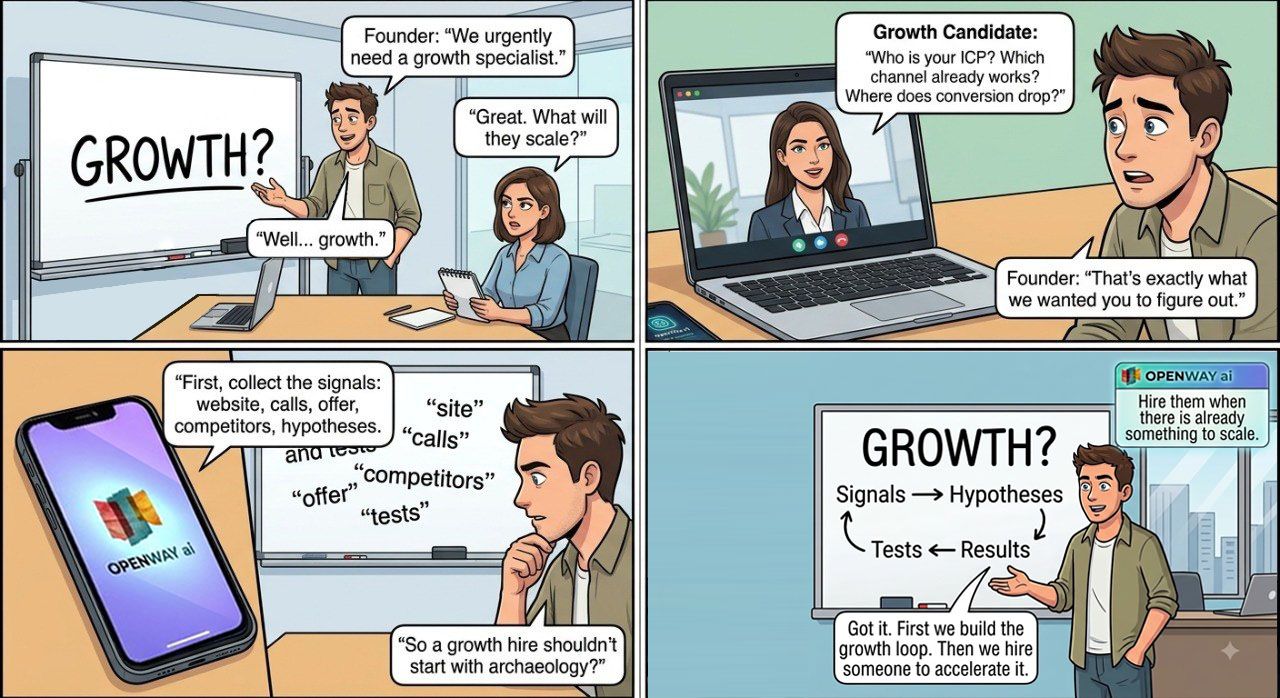
Growth rarely breaks because there are no ideas.
More often, it breaks because there is no system.
A founder may already have dozens of hypotheses: a new segment, a new offer, a new landing page, partnerships, outbound, content, paid traffic, referral growth, a better demo flow. The team understands that it needs to test more and move faster. Then the familiar question appears: who is actually going to pull this together, launch it, measure it, and turn the result into the next step?
This is when companies start asking whether it is time to hire their first growth specialist.
The short answer: not always.
A first growth hire is not needed simply because the business “wants growth.” Every business wants growth. The right time comes when the company already has enough signals to scale, and enough internal readiness to give one person real influence across product, marketing, sales, and analytics.
Before that point, the more effective model is often a combination of the founder, focused outsourcing, and AI tools.
A growth specialist should not be “the person who does everything”
One common mistake early teams make is hiring a growth specialist too soon and expecting one person to be the strategist, marketer, analyst, copywriter, performance manager, sales ops lead, and product manager at the same time.
That person should not simply “do marketing.” Their real job is to build a growth cycle.
They need to see a signal, form a hypothesis, launch a test, measure the result, and carry the learning into the next experiment. That requires access to data, customer conversations, the website, the sales funnel, the product, and the budget.
If a company does not yet have a clear ICP, a stable offer, basic analytics, and at least one channel showing signs of traction, the first growth hire can quickly become an expensive executor of chaotic tasks.
And expensive is the right word. According to Salary.com and SalaryGuide, Growth Marketing Manager compensation in the U.S. ranges roughly from $120K to $179K per year. So the question is not whether a company can “try hiring for growth.” The question is whether the business already has enough data, channels, and authority in place for that person to pay off.
A better question than “Can we afford a growth specialist?” is: “Do we have a system where this person can actually create results?”
When it is too early to hire
It is too early to hire your first growth specialist if the founder still cannot clearly answer a few basic questions.
Who is our best customer? Why do they buy? What did they try before us? How do they explain our value inside their own company? Which objections come up repeatedly in sales calls? Where exactly does conversion drop?
If those answers are still unclear, the company does not need a full-time growth hire yet. It needs faster market validation.
At this stage, AI tools and outsourcing often work better: competitor research, website analysis, first landing pages, email tests, messaging updates, analytics setup, customer call analysis, and testing several positioning angles.
The goal is not to hire someone “for growth.” The goal is to create the first pieces of proof: which messages resonate, which segments respond, which channels bring not just traffic but real movement through the funnel.
This matters even more now because AI has become a mainstream tool, but many companies have not yet learned how to turn it into business results. In its State of AI 2025 report, McKinsey writes that 88% of organizations regularly use AI in at least one business function, but only about one third have started scaling AI across the enterprise. The gap is clear: using AI is easy. Building it into a working growth process is much harder.
When outsourcing is better than hiring
Outsourcing is useful when the task is clear but does not require a permanent internal owner.
For example, you may need to build several landing pages for different segments. Run a competitor analysis. Set up tracking. Prepare an email sequence. Rewrite the website for a new offer. Launch a paid test with a limited budget. Analyze customer interview recordings and identify repeated language.
These tasks do not always require a full-time growth specialist. They require speed, experience, and a clear output.
But outsourcing has a limit: an external specialist does not live inside your business. They may execute well, but they will not always preserve context, connect a new insight to a previous hypothesis, or notice a weak signal between sales, product, and the website.
When it is time to hire your first growth specialist
A company should hire its first growth specialist when three conditions are in place.
First, there is repeatable demand. It does not have to be perfect product-market fit, but the company should already understand who buys, why they buy, and which segments are worth developing.
Second, there is a flow of signals. These may come from demo calls, inbound leads, paid traffic, organic traffic, referrals, trial users, email replies, or customer interviews. A growth specialist needs something to learn from. If there is almost no data, they will be building hypotheses in a vacuum.
Third, the founder is ready to give up part of the control over growth. Not just assign tasks, but give access to data, allow changes to messaging, test pages, adjust follow-up, ask questions to the sales team, and challenge current assumptions.
Without that, a growth hire will end up producing assets. With it, they can build a system.
A good moment to hire often looks like this: the founder can no longer process all the signals manually. Sales keeps hearing the same objections, but those objections never make it back to the website. Several channels show potential, but tests are moving too slowly. The team can see that growth is possible, but it still depends too much on one person’s manual attention.
That is when a full-time growth specialist starts to make sense.
What AI should keep doing even after you hire
Hiring a growth specialist should not mean stepping away from AI. On the contrary, a strong growth hire in 2026 should work with AI, not around it.
AI can take over the work that used to slow growth teams down: analyzing customer calls, finding repeated objections, comparing website messaging with the actual language customers use, generating landing page variants, preparing email tests, analyzing page performance, and turning insights into new hypotheses faster.
Gartner has reported that among marketing organizations already using GenAI, 77% use it for creative development tasks, while 47% report a large benefit from GenAI in campaign evaluation and reporting. This is an important signal. AI is not only useful for creating copy. It is starting to help in the areas where growth teams need speed most: analysis, testing, and deciding what to do next.
How OpenWay AI helps
OpenWay AI was built for the space between “it is too early to hire” and “growth can no longer be managed manually.”
The system helps businesses move faster from market signal to action. It keeps business context, analyzes the website, customer conversations, positioning, competitors, and test results. Then it helps launch landing pages, go-to-market experiments, email tests, and messaging updates based on what the market has already shown.
For the company, this means less manual context transfer between tools and more fast validation. The founder does not have to explain from scratch what the business sells, who it sells to, what the offer is, and which hypotheses have already been tested.
For a future growth specialist, this matters too. They do not enter a mess of scattered documents, calls, and landing pages. They enter a system with business memory, experiment history, and clear signals for the next decisions.
The takeaway
You should not hire your first growth specialist simply because the business needs growth. Growth is always needed.
You should hire when there is already something to scale: a clear market, early working channels, a flow of data, and the willingness to give one person real influence over the growth loop.
If that is not in place yet, there is no need to create an expensive role out of uncertainty. Use AI tools and focused outsourcing to test positioning, offer, channels, and customer signals faster.
The first growth hire should not arrive to replace chaos with heroics.
They should arrive to scale a way of learning from the market faster than your competitors.