How to Test a New Market Before You Commit to Expansion
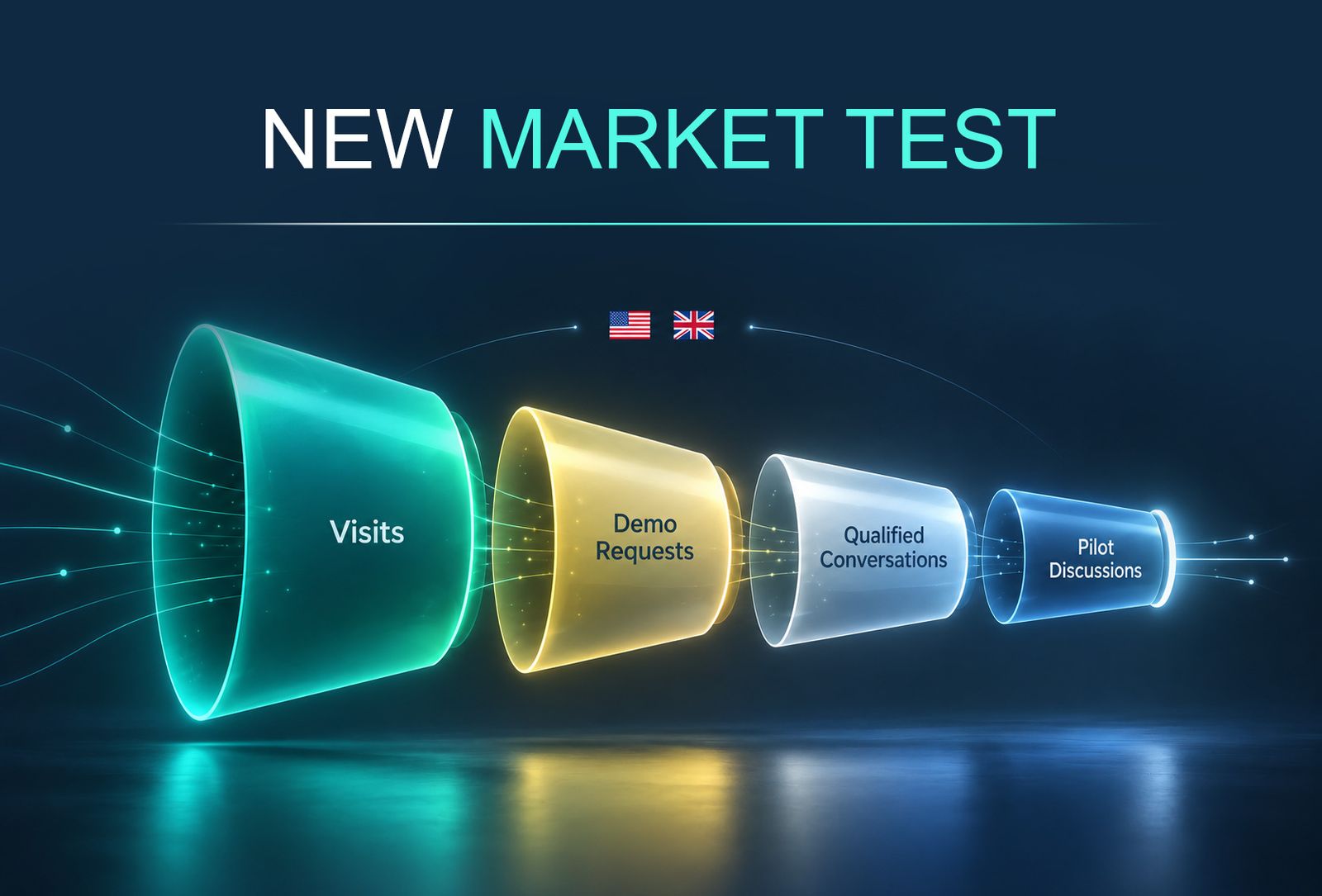
The fastest way to waste a market-expansion budget is to test the wrong thing. A landing page with a decent conversion rate tells you people clicked. It does not tell you whether the right businesses responded, whether they understood the offer, what they pushed back on, or whether any of them would actually move into a paying conversation. Before you commit a team and a real budget to a new country, you need evidence on those four questions, not a market report that says the opportunity looks attractive.
Here is how that played out with one of our clients, a B2B SaaS company at roughly $8M ARR selling scheduling software to field service businesses. We're not naming them, at their request, but the numbers below are real.
What counts as evidence that a market is worth it?
A handful of leads does not answer the question. Neither does a good landing page conversion rate on its own. This company had been getting occasional inbound interest from the UK and was weighing it as a first international market. Its CEO did not want confirmation that the UK looked attractive. He wanted to know if there was enough evidence to put a real budget and a real team behind it.
So before anything launched, the team agreed on what would count. A form fill was not enough. A lead counted as qualified only if the company matched the target profile, had a problem the product could actually solve, and was willing to discuss implementation and pricing. If the campaign could not produce at least five qualified sales conversations, there was little reason to increase the budget. If qualified prospects showed up but rejected the price or the offer, the next step was to revisit positioning, not spend more. If several qualified prospects moved past the first call, that would justify a second, larger test.
How do you turn years of scattered customer data into a real test?
The company was not starting from zero, even though it felt that way. Years of sales calls, CRM notes, support conversations, old landing pages, campaign reports, win and loss notes, and an earlier attempt to test Canada already existed. None of it lived in one place. One salesperson remembered that small contractors cared about scheduling. Another believed larger companies bought because managers lacked visibility into field operations. Marketing had a positioning document from the previous year. The Canada experiment had produced useful objections that had been sitting in a deck nobody had opened in months.
The team connected that material to OpenWay and asked it to prepare a UK test using what the company already knew: past positioning, pricing, sales objections, and the earlier international attempt. The first market and competitor pass took about 12 minutes. Nobody treated that as validation. It gave the team a starting hypothesis, which segment to test, which competitors prospects would likely compare them against, which parts of the US positioning might carry over, and which assumptions still needed evidence. The team reviewed the hypothesis before anything went live.
What happened once the test was actually live
The first landing page took about 18 minutes to build, including page structure, copy, visual direction, images, and a first version of the offer. The team reviewed it, changed two product claims, connected the domain, and approved it. Eighteen minutes did not mean the market test itself took eighteen minutes. It meant the time between agreeing on a hypothesis and putting something in front of real customers dropped from days to minutes.
The company also had 286 UK contacts already sitting in HubSpot from past inquiries, trials, and demos. OpenWay used that context to draft an outreach email; the first usable version took about 5 minutes, and marketing made a few edits before sending it. Alongside that, the team ran a limited Google Ads campaign, spending roughly $4,200 over two weeks on about 1,400 visits, close to $3.00 per visit. That's well under the $13.75 average cost per non-brand click that B2B SaaS companies typically pay on Google Ads, mostly because the campaign targeted a narrow, well-defined segment instead of broad category terms.
That traffic produced 70 demo requests. Nobody treated the raw click-to-demo number as the result. Sales rejected 20 of those requests: too small, outside the target segment, or looking for functionality the product did not have. That left 50 qualified conversations, a 71% qualification rate, a little above the 65-70% range most B2B SaaS teams see from their demo requests. Forty reached an actual first sales call. Twenty-four moved to a second conversation. Nine were willing to discuss a paid pilot at close to the company's existing US pricing. The email results were tracked separately from the paid campaign, on purpose, so the two sources would not blur into a number that looked better than either one actually was.
Why the conversion rate wasn't the finding that mattered
The more useful signal showed up in the sales calls themselves. The landing page used the positioning that had historically worked best in the US, built around reducing administrative work around scheduling and dispatch. UK prospects understood that message. They just did not react to it.
Across several calls, a different problem kept surfacing in slightly different words: once work moved from the office to crews out in the field, managers lost visibility into what was actually happening. After the fourth call, the team asked OpenWay to compare those conversations against the live landing page and flag where customer language and page language had drifted apart. That analysis took about 7 minutes. It proposed a new version built around operational visibility instead of administrative efficiency, and the revised page was ready in about 8 minutes. The team ran it against the original as an A/B test rather than replacing the page outright.
Version B did not double the conversion rate. It would make a tidier story if it had. What it did was shift the mix: a higher share of the leads it produced matched the target customer profile, even though total demo requests barely moved. That single change forced a conversation inside the company that the raw conversion number never would have: marketing had been optimizing for demo requests, sales cared about qualified conversations, and the CEO cared about whether any of this could eventually support the economics of entering a second country. The experiment put those three concerns in front of the same set of numbers.
What the company decided, and what it didn't
The company did not call the UK validated. The sample was too small to support that, and nobody pretended otherwise. What it had learned was more specific: qualified demand existed, some prospects would discuss the product at the current price, the US positioning was probably not the strongest fit for the UK, one segment produced noticeably stronger conversations than the broader audience, and the next test could be narrower and sharper than the first. That was enough to fund a second, more targeted experiment aimed at the segment that had produced the nine strongest opportunities. It was not enough to hire a UK sales team or open an office.
That distinction is the actual point of a test like this. The goal was never to prove the UK works. It was to find out, cheaply enough to survive being wrong, whether it might.
What actually got faster
The time saved was not the time spent on marketing tasks. It was the time between learning something and putting the next version of it in front of the market. A market and competitor pass in about 12 minutes. A landing page ready in about 18. A usable outreach email in about 5. A comparison between customer language and page language in about 7, with a revised page live about 8 minutes after that. None of those numbers replace judgment. Someone still has to decide what a qualified lead means, whether nine pilot conversations justify a second country, and which segment deserves the next round of budget. What changes is how quickly the business gets its next piece of evidence, and how much of what it already knew, buried in old calls and old decks, actually made it into the test.
FAQ
Do I need a large ad budget to test a new market? No. This test ran on about $4,200 over two weeks, at roughly $3.00 per visit, well below the typical $13.75 non-brand cost per click for B2B SaaS. The useful finding didn't come from the budget size, it came from tracking paid and organic leads separately and rejecting unqualified ones before counting a result.
What if the first landing page doesn't work? That's the expected outcome for a first pass, not a failure. Watching the actual sales conversations, not just the conversion rate, is what catches a positioning mismatch early enough to fix it in days instead of finding out after a full campaign.
How do I know if a lead is actually qualified? Decide the definition before you launch, not after you see the numbers. A workable version: the company matches your target profile, has a problem your product solves, and is willing to talk about implementation and price.
What's a good qualification rate for demo requests? Most B2B SaaS teams see 65-70% of demo requests turn into real sales-qualified conversations. This test landed at 71%, which suggests the targeting was tight, not that the raw traffic volume was the achievement.
Want to test a new market before committing a full budget?
Try OpenWay AI