How to Build Pricing That Lets You Grow Without Constant Discounts
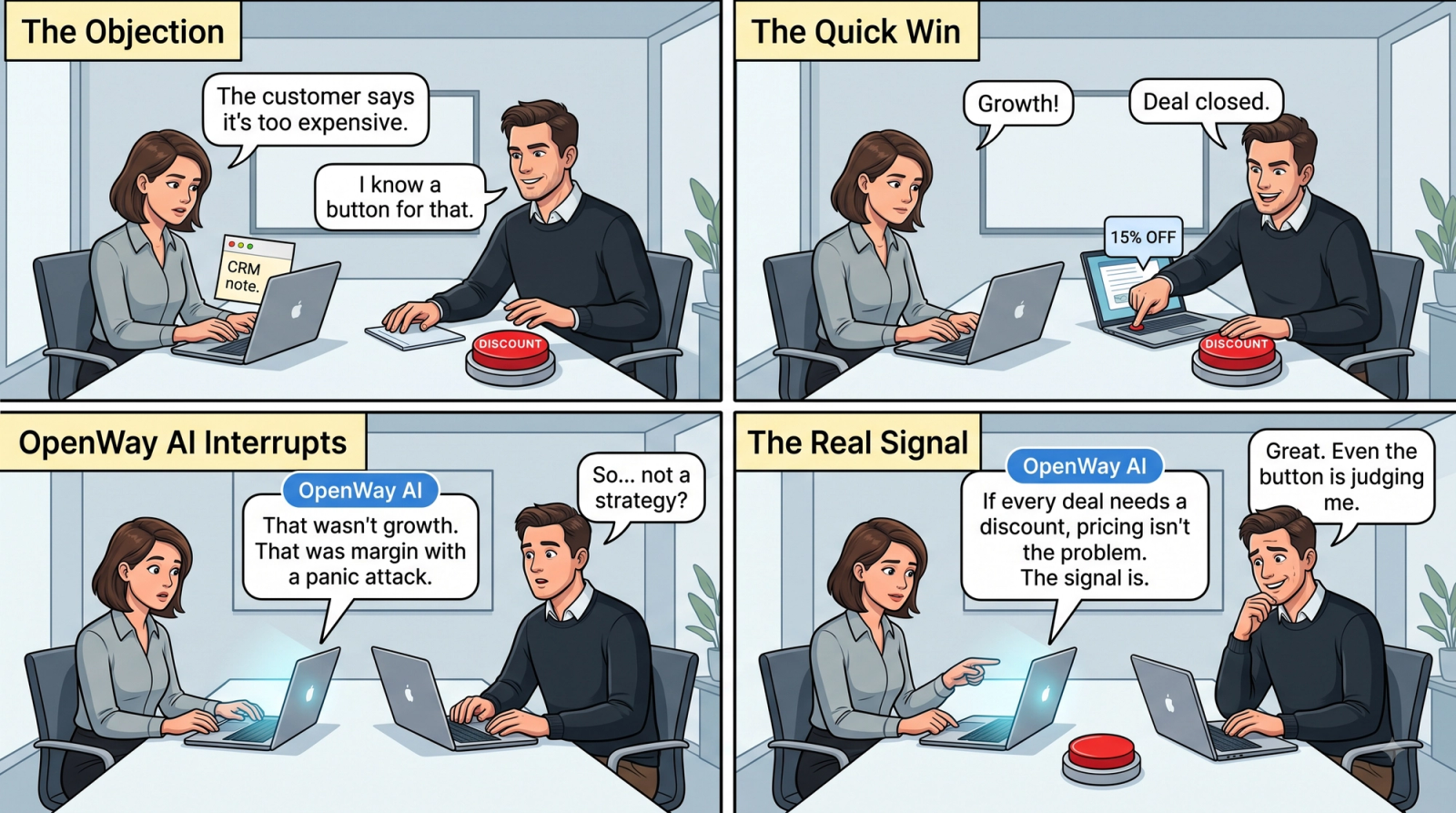
A discount often looks like the fastest way to accelerate a deal.
The customer is hesitating. The sales team is tired of a long cycle. The sales target is pressing. A competitor has already offered a lower price. In that moment, a discount feels less like a problem and more like a solution: “Let’s give them 15%, close this now, and figure it out later.”
But if discounts become a constant growth tool, the company almost always pays more for them than it seems.
It loses more than part of its margin. It loses clarity.
Constant discounts start to hide weak positioning, an uncertain sales team, poor product packaging, the wrong value metric, an overly broad ICP, weak onboarding, and the absence of a clear connection between price and the result the customer gets.
The problem is not the discount itself. Sometimes a discount is justified: for a longer contract, higher volume, prepayment, a strategic pilot, or a switch from a competing solution.
The problem starts when the discount stops being an exception and becomes the operating model.
At that point, the company is no longer managing pricing. It is renegotiating its right to grow every time.
Price is not a number. It is an architecture of value
Many teams think of pricing as a table: three plans, a list of features, monthly price, annual price, sometimes “contact sales.”
In reality, price is not the last line on a pricing page. It is business architecture.
It answers several questions at once: who gets the most value from the product, what result the customer is willing to pay for, how the customer understands that value before buying, how the price grows with usage, where enterprise value begins, which limits protect margin, and which features should lead to expansion.
If these questions are not answered, a discount becomes a way to patch the hole.
- The customer did not understand the value? Give them a discount.
- The package did not match the customer’s task? Give them a discount.
- A competitor explained themselves more clearly? Give them a discount.
- The decision-maker does not see the financial impact? Give them a discount.
But a discount rarely solves the real problem. It simply moves it inside the contract.
The company gets a customer who, from day one, has learned to buy not value, but a concession.
Why constant discounts break growth
A discount looks like a local decision, but its consequences are systemic.
It changes the behavior of the sales team. If a seller knows the deal can be closed with a discount, they start doing less work around value, urgency, segmentation, and the business case. The discount becomes not the final step in a negotiation, but a hidden emergency exit.
It changes customer expectations. If a customer receives a discount once without a clear reason, they will expect another one later: at renewal, during expansion, at upgrade, when adding new users. Price stops being a reflection of value and becomes the starting point for negotiation.
And it distorts data. The team looks at revenue growth and thinks pricing is working. But in reality, the company may be buying growth with future margin, lowering the quality of its customer base, and attracting a segment that retains worse.
The most dangerous part is that discounts can create the illusion of product-market fit.
If a product is bought only after a 30% concession, it does not always mean “the market is price-sensitive.” Sometimes it means the market does not see the promised value at the stated price.
Good pricing does not start with the question “how much?”
The first question should be different: what is the customer actually paying for?
Not for access. Not for features. Not for “AI,” “analytics,” “automation,” or a “platform.” The customer pays for a change in their business.
They pay for more leads, less manual work, faster campaign launches, fewer mistakes, higher conversion, clearer reporting, a shorter sales cycle, lower risk, faster decision-making, or a better customer experience.
Price should be connected to that change.
This is why pricing cannot be built only from competitors. Competitors matter, but they rarely show your real value. They show the market’s expectation range. And inside that range, the winner is not the company that is cheaper, but the company that explains more clearly why its price is fair.
In B2B, it is especially important for price to be not only acceptable, but explainable. The buyer needs to understand why this package costs what it costs, why the next package is more expensive, why an annual contract makes sense, why expansion is logical, and why a discount is not the main way to get value.
If the customer cannot retell the logic of your price inside their own company, pricing will slow down the deal.
“Too expensive” is almost never a complete diagnosis
When a team keeps hearing “too expensive,” the first reaction is usually: we need to lower the price.
But “too expensive” can mean very different things.
One customer truly has no budget. Another does not see urgency. A third is comparing you not with a direct competitor, but with Excel, an intern, an agency, an internal team, or the option of “doing nothing.” A fourth is simply not the segment for which your product creates the most value. A fifth is just used to asking for a discount.
If all these cases end up in one column called “price objection,” the company draws the wrong conclusions.
It is better to separate objections by cause: the customer does not understand the value, does not see urgency, lacks budget, is not the decision-maker, compares you with the wrong alternative, or wants a discount simply because they know how to negotiate.
These are different problems. And they require different solutions.
Lowering the price for everyone is the bluntest possible response to a signal that is far too complex.
The value metric matters more than a beautiful pricing table
One of the most common pricing failures is the wrong value metric.
A company chooses a simple metric because it is easy to count: users, seats, projects, storage, contacts, messages, credits. But billing convenience does not always match the logic of value.
If the product creates value not through the number of users, but through the amount of processed data, number of operations, time saved, number of customers, revenue impact, or level of automation, per-seat pricing can quickly start to conflict with reality.
It may be beneficial for the customer to give access to more people, but the pricing punishes them for expansion. Or the opposite can happen: one user may get enormous business value while paying like a small account.
In AI products, this problem has become even sharper. The provider’s cost may depend on compute, number of requests, task duration, data volume, and generation complexity. That is why many companies are moving away from a purely seat-based model toward hybrid models: subscription plus usage, credits, outcome-based elements, or limits based on usage intensity.
But the core logic remains the same: the price should grow when the value for the customer grows.
If the customer grows with you, the price should grow naturally. Not because you “raised the plan,” but because the customer uses more, gets more, and solves more important tasks.
Packages should reflect the customer’s stage of maturity
Good pricing helps the customer recognize themselves.
Bad pricing forces them to read a feature table and guess which plan they need.
If you have three plans, they should not simply mean “small, medium, large.” They should reflect different customer states.
The first package might be for a team that is just launching a process and wants to get a result quickly. The second might be for a company that already sees value and wants to systematize the work. The third might be for a business where the product becomes part of the operating system and affects teams, processes, data, governance, and scaling.
Then the customer is not choosing a set of checkmarks. They are choosing their current stage.
This is especially important for growth without discounts. When packaging is tied to maturity, it is easier for the sales team to explain an upgrade. The customer understands that the next plan is not “the same features for more money,” but the next level of the task.
Price becomes part of the customer journey.
Not every concession has to be a discount
Companies often give discounts because they have not prepared other forms of concession.
But a discount is only one way to change a deal. And it is far from always the best one.
You can offer annual billing instead of monthly. You can add onboarding support. You can expand a limit for the pilot period. You can give access to an additional template, report, role, integration, or consultation. You can lock in the price for an annual contract. You can offer a phased rollout. You can create a pilot with clear success criteria, after which the full plan begins.
The difference is fundamental.
A discount lowers perceived value.
A smart concession helps the customer reach value faster.
In mature pricing, a discount should be tied to a reciprocal commitment: longer term, higher volume, prepayment, a public case study, a joint pilot, team expansion, or predictable usage.
If the company gives something up, it should get something in return.
Otherwise, it is not a pricing strategy. It is an anxiety response.
Discounts do not always speed up sales
One reason discounts survive so well is the belief that they shorten the sales cycle.
Sometimes they do. But not always.
In its Go-To-Market Report, ChartMogul analyzed data from 2,500 SaaS companies and highlighted an important effect: for deals with an ASP from $100 to $1,000, sales cycles for median and top-quartile companies look similar with and without discounts. In other words, in many cases, the discount does not make the deal faster. It only makes it cheaper.
That is an important signal for founders and revenue teams.
If a discount does not accelerate the deal, improve retention, increase the likelihood of expansion, or open a strategic segment, it should be treated not as a growth lever, but as leakage.
In B2B, growth is not built on how quickly you concede. It is built on how quickly the customer understands value.
Pricing governance is needed earlier than it seems
At early stages, governance can feel like something meant for big companies.
In reality, pricing governance is needed the moment discounts stop being rare exceptions.
Governance does not mean bureaucracy. It means simple rules: who can give a discount, within what limits, for what reason, under which conditions, how it is reflected in the CRM, who sees deviations, which discounts require approval, and how the quality of the deal is measured after closing.
Without this, the company loses pricing memory.
A few months later, no one remembers why one customer pays $800, another pays $1,200, and a third pays $2,000, even though they all use almost the same thing. The sales team gets used to individual arrangements. Finance does not understand the real unit economics. Customer Success receives customers with different expectations. Product does not understand which features truly create willingness to pay.
Not every company needs a complex system. But every growing company needs logic that prevents discounts from quietly becoming the business model.
Where to look for opportunities to raise price without losing growth
Companies often fear raising prices because they see it as a risk of losing customers.
But sometimes the bigger risk is not revisiting pricing for years.
McKinsey has long shown how powerful pricing impact can be: on average, a 1% price increase while maintaining volume can produce an 8.7% increase in operating profits. In the same work, McKinsey notes that up to 30% of pricing decisions fail to deliver the optimal price, while more granular pricing at the product and segment level in company projects produced margin lift from 3% to 8%.
This does not mean every company should raise prices by 10% tomorrow.
It means pricing should not remain in the state of “we decided this once.”
Opportunities for price growth are not only on the pricing page. They may be in packaging, limits, add-ons, annual plans, enterprise tiers, onboarding fees, usage thresholds, premium support, compliance features, integrations, reporting, templates, speed, governance, security, or simply a more precise explanation of value.
Sometimes the price does not grow because the product is cheap.
More often, the price does not grow because the company has not separated basic value from premium value.
How to build pricing without constant discounts
The first step is to describe who gets the most value from the product.
Not who can buy it. Who gets such clear business impact that the price becomes rational. This is your pricing-core ICP. Not a marketing persona, not the entire audience, not “SMB and enterprise,” but the segment where value turns into willingness to pay the fastest.
The second step is to define the value metric. Price should be connected to what grows together with customer value.
The third step is to rebuild packages around customer maturity. Plans should help the customer move forward, not simply unlock more features.
The fourth step is to separate a discount from an incentive. A discount without conditions destroys value. An incentive for an annual contract, volume, prepayment, or expansion can strengthen the business model.
The fifth step is to give the sales team the language of value. If sellers cannot explain the price, they will lower it. That is why pricing should be connected to messaging, battlecards, ROI logic, objections, and customer stories.
The sixth step is to introduce discount governance. Even a simple table of rules is better than “everyone decides on their own.” What matters is not only who gave the discount, but why, to which segment, for which reason for refusal, and what happened to that customer after 3, 6, and 12 months.
The seventh step is to constantly return market signals back into pricing.
Pricing should not change every week. But it should learn.
If customers keep asking about the same limit, maybe that is the value metric. If enterprise customers buy only after security features are added, maybe that is a separate package. If small customers require a lot of support and pay little, maybe that segment should not be the foundation of growth. If customers leave after a discounted pilot, maybe you attracted the wrong buyers.
Price should not be a static table. It should be a feedback system.
What AI can do in pricing
AI should not “set the price” instead of the team.
That is a bad idea, especially in B2B, where price depends on segment, context, company stage, urgency, alternatives, the internal buyer journey, and real value perception.
But AI can help reveal what the team usually notices too late.
It can collect objections from calls, emails, CRM, support tickets, and meeting notes. It can show where “too expensive” means lack of value, and where it means poor segment fit. It can compare which segments ask for discounts more often and which of them retain worse later. It can connect pricing objections with landing page messaging, the sales deck, onboarding, product usage, and customer success signals.
AI is especially useful not in the moment of “what price should we set,” but in the question “what does our current price tell us about the market?”
- If customers buy only with a discount, what exactly did they not understand?
- If one segment pays without negotiating and another requires concessions, where is the real value?
- If a cheaper competitor keeps winning, are they winning on price or clarity?
- If upgrades are weak, is the problem the price, the packaging, or the fact that the customer does not see the next step?
This is where AI can become not a discount calculator, but a pricing intelligence system.
How OpenWay AI helps work with pricing signals
OpenWay AI helps teams look at pricing not as a separate table, but as part of the growth system.
The platform collects business context from different sources: the website, CRM, meetings, emails, notes, customer conversations, and internal materials. Then it helps identify where a pricing objection is connected not only to price, but to a broader growth problem: positioning, segment, offer, onboarding, landing page, sales narrative, or customer value.
For example, if “too expensive” keeps appearing in calls, OpenWay AI can help unpack what is actually behind that signal: unclear value, weak proof, the wrong package, lack of urgency, or comparison with the wrong competitor.
If customers with the same profile buy without discounts while another segment constantly requires concessions, that can become the basis for revising the ICP, pricing page, email campaign, sales deck, or onboarding flow.
If the team is preparing a new package or wants to test a higher price, OpenWay AI can help gather market context faster, analyze competitors, prepare a landing page, formulate a value proposition, launch an A/B test, and return the results into business memory.
OpenWay AI does not replace founder judgment, finance discipline, or sales experience. It helps connect pricing signals to action faster: what to test, which segment to separate, which offer to rebuild, which hypothesis to validate, and where the discount is hiding the real problem.
Conclusion
Growth without constant discounts does not begin with the hard phrase “we no longer give discounts.”
It begins with an honest question: why do we have to give them in the first place?
Sometimes the answer is simple: the market is not ready. Sometimes the product is genuinely overpriced. Sometimes the competitor is stronger. But very often, the problem is not the price itself.
The problem is that value is poorly explained, packages do not reflect customer maturity, the sales team is not equipped with arguments, pricing is not connected to usage, and the company does not see which discounts support growth and which ones simply eat away at the future.
Strong pricing does not forbid flexibility. It makes flexibility intentional.
A discount can be a tool. But it should not be a crutch.
If a company wants to grow sustainably, the price should grow together with the value the customer receives. And the team should see not only “how much the customer paid,” but also why they agreed, why they asked for a discount, why they expanded, why they left, or why they chose a competitor.
Pricing is not a financial setting at the end of the product.
It is one of the most honest ways to understand whether the market truly sees your value.
And if a company learns to read these signals earlier, it will need to buy growth with discounts less often and earn it with clarity more often.