How to Build an Early Warning System for Unhappy Customers Before They Leave
Customers rarely leave suddenly. It only looks sudden in the CRM.
Yesterday, the customer was active. Today, they did not renew, canceled the contract, stopped responding to the account manager, or sent a short email: “We’ve decided not to continue for now.”
But there were almost always signals before that.
The customer started using the product less often. They began asking questions they had never asked before. They stopped showing up for calls. Their replies got shorter. They asked you to “send the pricing again.” They opened a support ticket that was not about a bug, but about frustration. They stopped pushing back, even though they used to. They stopped asking for new features, even though they used to share ideas all the time.
Someone on the team had probably already said, “I think they’re cooling off.” But that thought stayed in an account manager’s head, in a call note, or in a Slack thread that no one connected to churn risk.
The biggest mistake companies make with unhappy customers is acting only after the customer has already made the decision to leave.
An early warning system is not about making a churn report look better. It is about spotting dissatisfaction while there is still time to do something about it.
Unhappy customers do not always complain
The most dangerous customer is not always the one who writes an angry email.
An angry email often means the customer is still engaged. They are unhappy, but they still have enough energy to explain what is wrong. They still believe the situation can be fixed.
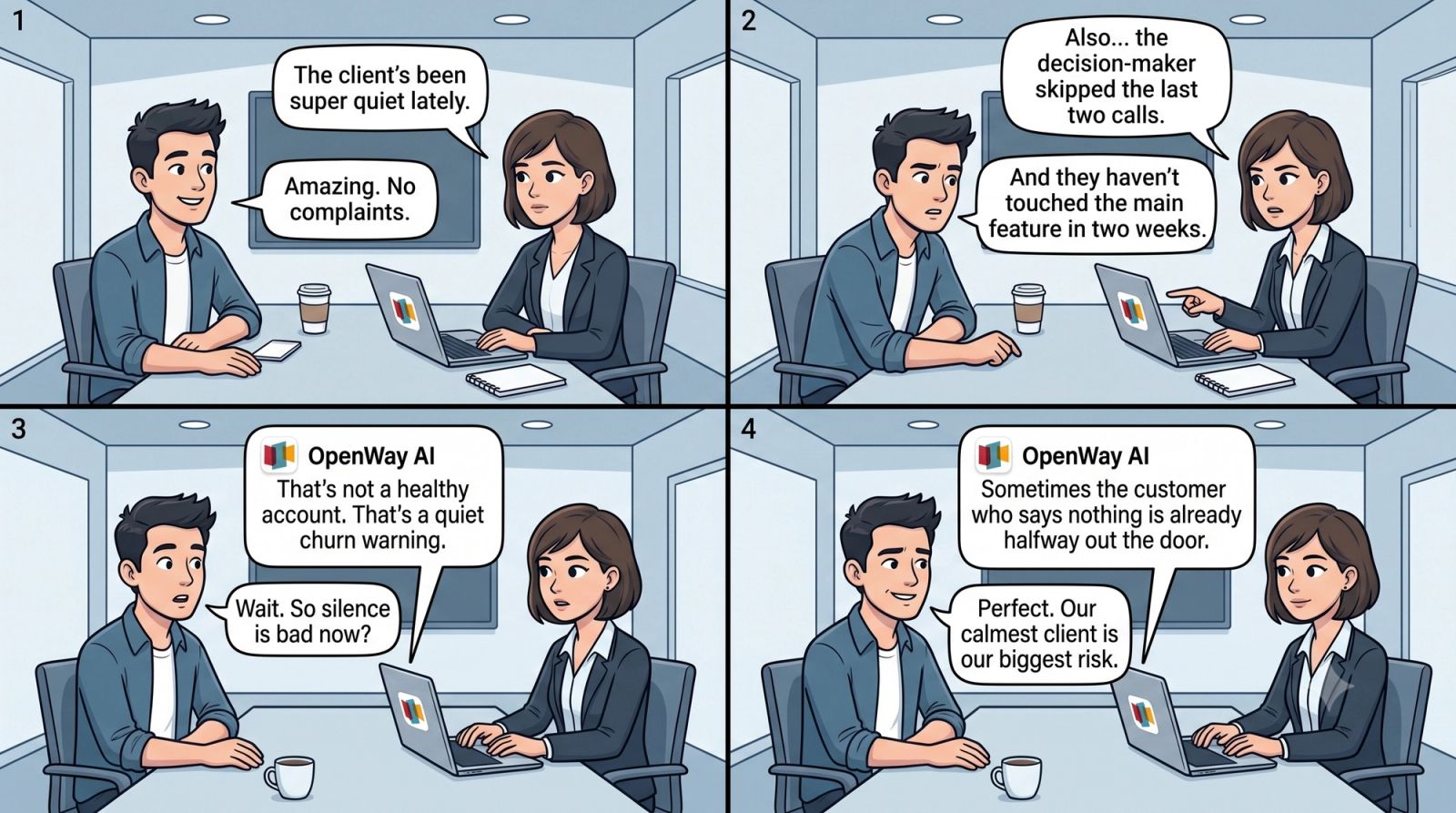
The more dangerous customer is the quiet one.
They stop asking questions, requesting improvements, pushing back in meetings, opening reports, checking analytics, using key features, or involving their team. Companies often read silence as the absence of a problem, while in B2B, silence often means the customer has already started leaving emotionally.
They are still paying. They are still in the database. They still show up in reports as an active account. But internally, they are already comparing alternatives or preparing the argument for why renewal no longer makes sense.
That is why an early warning system should not only look for complaints. It should look for changes in behavior.
First, you need to understand what a healthy customer looks like
You cannot spot deviation if you do not understand the norm.
Many companies try to build churn prediction from the end point: who left, why they left, and what signals appeared before they left. That is useful, but it is not enough. You also need to understand what a customer looks like when they stay, expand, recommend the product, and get real value.
For one business, a healthy customer logs into the product every day. For another, that may not matter because value appears once a month in a report. For an agency, a healthy customer may rarely write, but still approve materials on time and expand the scope of work. For a SaaS platform, a healthy customer may actively use three key features, even if they barely talk to support.
So the starting point is not an abstract question like “is the customer happy or not?” It is a customer health map.
You need to understand what customers do when they are actually getting value: which features they use, which meetings they attend, which results they discuss, how often they return, who inside their company is involved, what questions they ask during a healthy stage of the relationship, and which signals usually appear before an expansion.
Once the norm is clear, dissatisfaction becomes visible earlier. Not as a feeling, but as a deviation from the expected pattern.
Where to look for early signals of dissatisfaction
The main problem is not that there are too few signals. Usually, there are too many, and they are scattered across different places.
Support sees frustration in tickets. Sales hears hesitation on calls. Customer Success notices that the customer keeps rescheduling meetings. Product sees a drop in feature usage. Finance sees a payment delay. The founder hears “yes, everything is fine” on a personal call, but senses that everything is no longer fine.
Each signal looks weak on its own. A customer missed one call, opened fewer emails, did not log into the product for two weeks, or asked you to send the pricing again. Nothing dramatic.
But together, those signals may mean one thing: the customer has already started leaving.
An early warning system should not only look at complaints. It should recognize changes in behavior, communication, and perceived value. Behavioral risk may show up when a customer uses the product less often, stops using a key feature, does not invite new users, or does not return to important use cases. Communication risk becomes visible when replies get shorter, meetings are rescheduled, the decision-maker disappears from the conversation, and the customer keeps saying, “We’ll discuss it internally.” Value risk appears when the customer cannot describe the result, does not bring new use cases, and does not talk about the next stage.
Financial signals matter too: pricing questions, payment delays, requests to recalculate the plan, and comparisons with alternatives. But emotional tone matters just as much. Emails and calls may start to carry fatigue, irritation, formality, or, even worse, complete indifference.
Why NPS will not save you
NPS, satisfaction surveys, and feedback forms can be useful. But they should not be the main way you understand whether a customer is unhappy.
Many customers do not fill out surveys. Some respond too late. Someone may give a neutral score while they have already decided not to renew. Someone may write “too expensive,” when the real problem is that the team never saw value. Someone may say “we do not have time,” when the truth is that the product never became a habit.
A survey shows what the customer is willing to say. An early warning system should also show what the customer actually does.
How to build an early warning system
Start not with a dashboard, but with a simple question: what does a healthy customer look like in your business?
Once the norm is clear, deviation becomes visible.
Next, define your “yellow flags.” Not red flags, when the customer is already saying, “We are thinking about leaving,” but early signals.
For example, a yellow flag may not be one dramatic event. It may be a series of small changes: the customer has not used a key feature for two weeks, the decision-maker has missed a second meeting, no second user appeared in the product after onboarding, several tickets have been opened about the same issue, and the team received no reaction after sending a report. Sometimes the risk is stated directly in conversation: “We still do not understand the impact,” “What exactly is included in our plan?” or “We looked at another solution.”
Every business will have its own flags. What matters is that they do not live only inside a Customer Success manager’s head. They need to be documented, and the team needs to agree on what happens next.
If activity drops, someone needs to understand whether the customer has lost value or simply does not understand the next use case. If the decision-maker disappears from communication, the conversation needs to return to business outcomes. If the customer asks about price, the first reaction should not be a discount, but a conversation about the value they are getting or not getting. If support issues repeat, that pattern needs to return to product, onboarding, or communication.
If the system only shows risk, but no one owns it, it is not a system. It is just another report.
The most important signal: the customer stopped seeing a future with you
There is one simple question that is useful to ask about every important customer: do they see the next step with us?
Not “are they happy right now?” Not “are they paying right now?” The question is whether they have a reason to keep moving forward.
If the customer does not see the next step, they become vulnerable. Even if everything looks calm today.
Strong customer relationships are not built only on solving the current task. They are built on the feeling that, with you, the customer is moving forward: getting more value, unlocking new opportunities, saving time, growing faster, avoiding risk, or understanding their business better.
When that feeling disappears, a competitor does not need to be much better. They only need to appear at the moment when your customer is already internally ready for change.
What AI can do today
Early detection of dissatisfaction used to depend almost entirely on people.
A good account manager could sense risk. A strong founder could catch a change in tone. An experienced Customer Success lead could notice that a customer was “responding differently.”
But that kind of system does not scale well. The more customers you have, the more signals get lost.
AI can change not the nature of customer work, but the speed at which risks are detected. It can analyze calls and find repeated objections, compare what the sales team promised with what the customer actually received, identify drops in product activity, connect support tickets to churn risk, and notice when the same question appears across different customers after the same onboarding stage.
Most importantly, AI can connect signals that used to live separately.
Not instead of the team. Before the team loses time.
Because customer dissatisfaction rarely begins on the day they write the cancellation email. It starts earlier, in small changes that a person may miss, but a system should catch.
How OpenWay AI turns warning signals into next actions
OpenWay AI is the growth layer that runs on your company’s own operating memory. For retention, that operating history can include customer conversations, CRM context, support signals, account activity, and previous interventions. Looking at those signals together makes it easier to distinguish an isolated event from a pattern that deserves attention.
The useful part is what happens next. If several customers ask the same question after onboarding, that pattern may point to product logic, documentation, sales messaging, or expectations created before the deal closed. If a customer starts questioning price after usage drops, the issue may be perceived value rather than the number on the invoice.
This history becomes part of business memory, so what the company learns from one account can improve later retention work instead of remaining in an account manager’s notes.
Pricing is a good example of why the signals need to stay connected. A request for a discount can be a negotiation tactic, but it can also reveal that the customer has stopped seeing enough value. We look at that distinction more closely in our guide to building pricing without relying on constant discounts.
OpenWay AI can help prepare the analysis and next-step work, while external actions remain under human control. You approve anything that leaves the building.
Retention also should not sit outside the rest of growth. What a company learns after the sale can change acquisition, positioning, onboarding, and the next campaign. That is why the growth layer that runs on your business memory treats Retain as part of the same cycle as Research, Attract, Convert, and Close.
Conclusion
An unhappy customer almost always speaks to the company before leaving.
Sometimes they speak with words. Sometimes through silence, lower activity, a pricing question, the absence of a decision-maker from meetings, or a short phrase like “we need to discuss this internally.”
The goal is not to force the customer to be happy. The goal is to understand earlier where value has stopped being obvious.
Companies lose customers not only because the product is bad. They lose customers because they notice too late the moment when the customer stopped believing in the next step.
An early warning system for dissatisfaction is not a churn report. It is a way to hear the customer before they leave.
And the faster a company learns to see these signals, the better the chance that the next conversation will not be about cancellation, but about how to restore value.
OpenWay AI helps teams turn scattered customer signals into clear next actions: what to check, where to restore value, which conversation to prepare, and which risk cannot be ignored.
Share this article