How to Build a 3-Year Growth Strategy Without Losing the Flexibility to Change Fast
Most three-year strategies that companies write at the beginning of the year stop matching reality by May. Not because the team planned poorly, but because the market, competitors, technology, and customer behavior change faster than the strategic planning cycle.
At some point, every entrepreneur faces the same question: why build a three-year strategy at all if you will have to rewrite it anyway?
The answer is simple: a three-year strategy should not be a fixed action plan. It should be a system of direction, one that makes fast change manageable instead of chaotic.
Why traditional strategic planning does not work
One number explains a lot: 90% of companies that find the time to create a strategic plan fail to execute it, according to LLCBuddy, 2025.
The issue is not that the plans are bad. The issue is that the plan is created as a static document, while the business lives in a dynamic environment.
Another telling detail: 86% of leadership teams spend less than one hour per month discussing strategy.
The pattern is familiar. In January, the company holds a big strategy session. A polished 40-slide deck is created. Then the rest of the year is consumed by operations, and the strategy is remembered only at the next January session, when half of the original assumptions have already failed.
At the same time, 2025 business agility research makes one thing clear: the era of stable periods between shocks is over. Pressure on businesses is now constant. Economic uncertainty, geopolitical shifts, and technological change create an environment where companies must keep adapting all the time.
In this environment, a three-year plan written once and treated as final becomes outdated almost immediately.
What should actually be fixed for three years
The paradox is that some things really should be fixed over a longer horizon. In fact, when they are not fixed, fast change turns into chaos.
If a company does not have clear answers to the questions below, every tactical decision becomes a debate from scratch.
1. Who you serve.
Not the “target audience” in a broad sense, but the specific customer profile for which your product creates the most value. This profile may become more precise over time, but the basic understanding of “who we exist for” should remain stable for years. If a company changes its ICP every six months, that is not flexibility. It is lack of focus.
2. What problem you solve better than others.
Not a list of features, but the core of your competitive advantage. Technologies, channels, and tactics will change, but the reason customers choose you should remain recognizable.
3. Which metrics define the health of the business.
These are not KPIs for individual teams, but 3-5 top-level indicators, such as NRR, LTV/CAC, or revenue growth per employee, that help leadership understand whether the company is moving in the right direction, regardless of which tactical experiments are running in parallel.
4. Which constraints cannot be violated.
This could be minimum margin, regulatory requirements, or principles for working with customer data. Flexibility does not mean “anything goes.” It means that inside these boundaries, almost anything can change quickly.
These four elements are the real three-year strategy.
Everything else, channels, tactics, specific products and features, team structures, should be flexible by default.
The model: horizons instead of a straight line
The most common mistake in strategic planning is treating strategy as one straight line from point A to point B over 36 months. If something changes in month six, the whole line has to be recalculated.
A better alternative, used by more mature companies, is a three-horizon model.
Horizon 1: 0-6 months, operational execution.
Specific tasks, sprints, and experiments. This is where flexibility is highest, and changes happen weekly based on data.
Horizon 2: 6-18 months, growth directions.
New segments, channels, or product lines the company is exploring. Flexibility is moderate here. Directions may change quarterly based on results from Horizon 1 experiments.
Horizon 3: 18-36 months, positioning and scale.
Where the company should be in terms of revenue, markets, and structure three years from now. Changes happen less often here, every six to twelve months, and only when fundamentally new information appears.
The key idea is that Horizon 1 constantly produces data that can adjust Horizon 2, while accumulated results from Horizon 2 can eventually adjust Horizon 3.
Information flows from the bottom up, not from the top down.
According to the 2025 business agility report, organizations that treat change as a continuous process, rather than a one-time project, perform better. Regular cycles of strategic iteration replace fixed multi-year plans.
Review rhythm: how often you should actually return to strategy
A simple rule applies here, and many companies instinctively violate it: the closer the horizon, the more often it should be reviewed. But reviewing Horizon 3 does not mean rewriting everything from scratch.
Strategy review checklist:
- Weekly: operational metrics and experiments, Horizon 1. Decision: continue, adjust, or stop.
- Monthly: movement in the company’s key business metrics. Decision: does anything need to change in Horizon 2 directions?
- Quarterly: review growth directions based on accumulated data. Decision: which hypotheses were confirmed, and which can be closed?
- Every six to twelve months: review positioning and three-year goals. Decision: does the core logic of the strategy still hold, or has new information appeared that requires a change?
At quarterly and semiannual reviews, the question should not be, “What new thing should we add to the strategy?”
The better question is, “What part of the current strategy is no longer supported by data, and what are we willing to change because of that?”
A good strategy session should end not only with new ideas, but also with a list of things the company is consciously choosing to stop doing.
Where companies lose flexibility, even when they think they are agile
Many companies believe they are flexible because they have sprints, task boards, and weekly syncs. But team-level flexibility and strategy-level flexibility are not the same thing.
Business agility research notes that if leadership continues to work within rigid annual planning cycles, or if departments operate in isolation from each other, agile teams quickly hit a ceiling.
In practice, it looks like this: the product team works in short cycles and tests hypotheses quickly, but the marketing budget was allocated for the full year and cannot be reviewed until the next financial cycle.
Or the sales team receives a quarterly plan based on a segment that the growth team has already deprioritized based on experiment results, but no one has formally updated the sales plan.
Real flexibility requires budgeting, hiring, and goal-setting mechanisms to follow the same review rhythm as the strategy itself, instead of living in a parallel universe with a fixed annual cycle.
The role of AI: not to predict the future, but to shorten the cycle between signal and decision
The biggest bottleneck in adaptive strategy is not the lack of ideas about what to change. It is the speed at which the company notices that something needs to change.
While the team manually collects reports across channels, combines them in spreadsheets, and discusses them at the next scheduled meeting, weeks or even months may pass between the moment a signal appears and the moment the company reacts to it.
Modern approaches to business agility emphasize that AI can be a powerful tool for success, but it is not a shortcut by itself. In other words, AI does not replace strategic thinking. But it can radically reduce the time between a change in the data and the moment a decision-maker sees it.
AI should not “guess the future” instead of the team.
Its more practical role in a growth strategy is different: it can notice signals faster, connect them to the business context, and help turn an observation into action.
This is where OpenWay AI can be especially useful.
How OpenWay AI helps build a flexible growth strategy
OpenWay AI is not designed to write a strategy once and leave it in a presentation.
Its purpose is to help a business turn strategy into a living cycle: observe signals, test hypotheses, launch actions, and return the results back into the system.
First, OpenWay AI helps build a baseline understanding of the business. The system studies the website, analyzes the company, and helps create a Business Profile: products, audiences, competitors, positioning, pricing, strengths, and possible growth directions.
This is especially important for a three-year strategy because the team gets more than an abstract document. It gets a working foundation that can be used in the next actions.
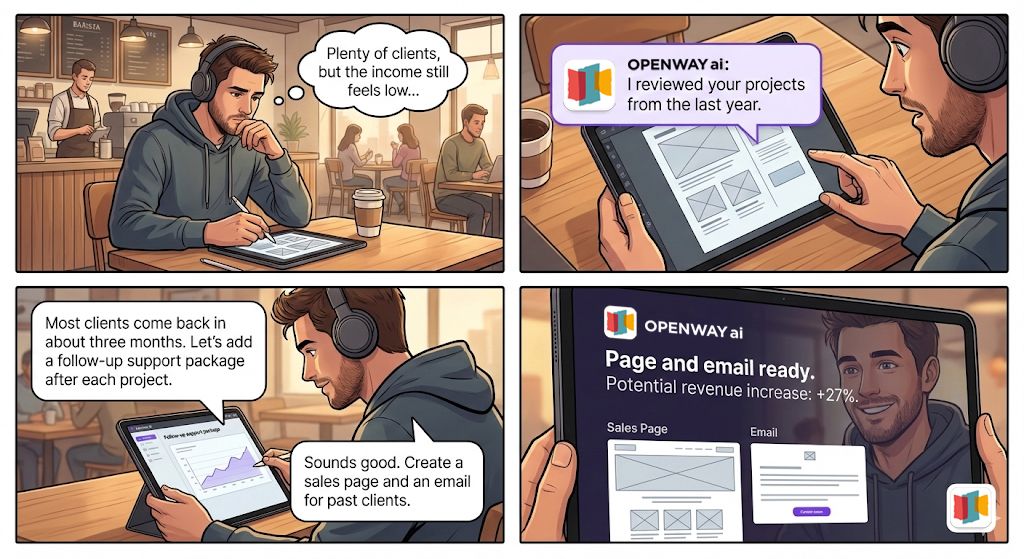
Then OpenWay AI helps move from strategy to tests. If a company has a hypothesis around a new segment, offer, or positioning, the system can help create a landing page, prepare a marketing email, suggest a campaign, shape the messaging, and launch a test faster than if the team had to build everything manually from scratch.
The main value is not that AI “writes copy” or “creates pages.”
The value is that every next step is grounded in the memory of the business: what the company sells, who it sells to, which arguments it has already used, which customers are coming in, which objections repeat, which hypotheses have already been tested, and what past experiments showed.
This turns Horizon 1 from a set of disconnected tasks into a constant source of signals for Horizons 2 and 3.
For example, if a new page converts one segment better, that may influence growth priorities for the next 6-18 months. If the same objection keeps coming up in sales calls, that may change the messaging, landing page, or sales deck. If customers from a certain channel retain better and expand usage more often, that may affect budget allocation and strategic focus.
OpenWay AI does not make strategic decisions instead of the team. Important external actions remain under user control: anything that sends, publishes, or spends budget requires approval.
But the system helps shorten the path from signal to decision.
Instead of waiting for the next quarterly meeting, the team can see faster which hypothesis is working, which segment deserves more focus, which channel is losing efficiency, which offer needs to be revisited, and which customer insight should return to the strategy.
That is practical flexibility: not changing the strategy every day, but constantly updating the company’s understanding of what is supported by data and what no longer works.
Final checklist: 7 questions to test your growth strategy
- Can you name the four stable elements of your strategy, who you serve, what makes you different, which metrics define business health, and which constraints cannot be violated, in one minute without preparation?
- Is your strategy divided into horizons with different review rhythms, or is it one three-year plan with no internal structure?
- When was the last time you formally removed part of your strategy based on new data, instead of simply adding something new?
- Are your budgeting and hiring cycles connected to the same review rhythm as the strategy itself?
- How much time passes between the moment a metric starts moving away from the norm and the moment leadership learns about it?
- Does every team understand which Horizon 1 experiments they are running and how the results should influence Horizon 2?
- If fundamentally new information about the market, competitors, or technology appeared tomorrow, do you have a process that would let you revise the strategy quickly, or would you have to wait for the next annual session?
Flexibility and strategy do not contradict each other.
A rigid plan and no plan at all contradict each other.
Companies that grow sustainably over a three-year horizon are usually not the ones that predicted the future better than everyone else. They are the ones that built a system capable of noticing change quickly and adjusting tactics without losing sight of what truly remains constant.
That is why we are building OpenWay AI: so growth is not a collection of random actions, but a system that learns together with the business.
If you want to build a growth strategy that does not become outdated after a few months, join the OpenWay AI community. We bring together entrepreneurs, marketers, and teams that want to test hypotheses faster, better understand their growth signals, and turn strategy into a continuous cycle of improvement.
Join the OpenWay AI community and start building a growth system that can adapt as fast as your market changes.