Business Memory Factory: How OpenWay AI Remembers Your Business
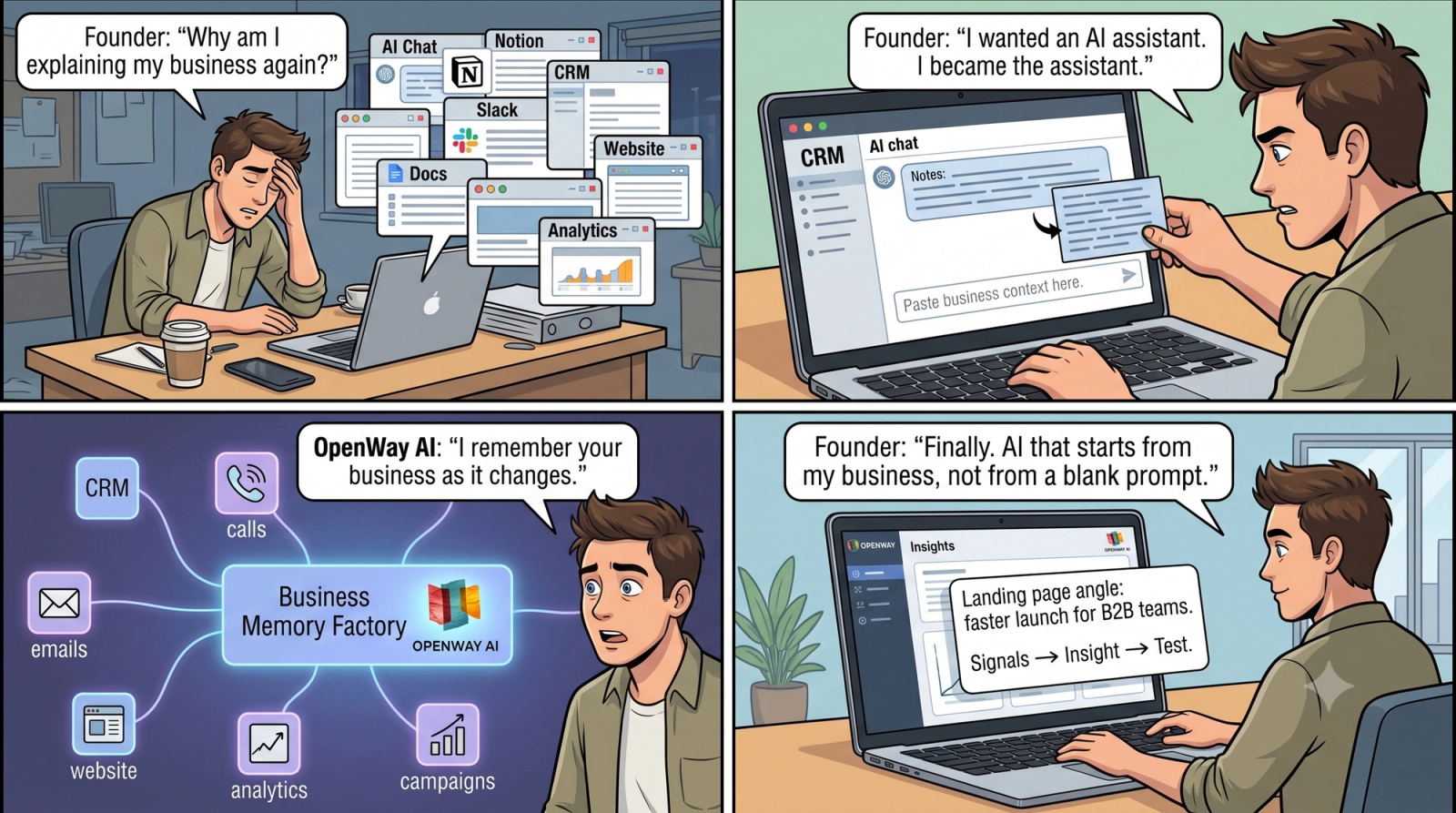
Every AI tool today promises to “remember context.”
That sounds useful. You upload documents, connect your CRM, add a few links, and the AI should understand your business. But after a few weeks, something else often happens: it remembers something, but not always the thing you need. It uses old data. It confuses hypotheses with decisions. It pulls from a random document instead of what you said yesterday in a meeting.
The hard part is not saving information. Almost anything can be saved.
The real challenge appears when there is a lot of data. The AI has to understand which information to retrieve at the right moment, what to trust, what is outdated, and what is allowed into a specific answer.
That is why OpenWay AI has Business Memory Factory.
In the product, users see it more simply: it is your Memory. Business Memory Factory is the internal machinery that collects, organizes, updates, and uses knowledge about your business.
Why ordinary “memory” is not enough
Imagine that over a year, a company has collected:
- 50,000 emails,
- 12,000 chat messages,
- CRM data,
- meeting recordings,
- a website,
- analytics,
- A/B tests,
- campaigns,
- presentations,
- Notion documents.
At first, it sounds simple: upload all of this into AI, and it will know the business.
But if you later ask, “Why did conversion drop?” or “Which landing page should we launch for a new segment?”, the AI needs more than similar text. It needs the right context.
A current pricing page matters more than an old one. A founder’s decision matters more than a random brainstorm note. Real customer objections matter more than a polished phrase from last year’s presentation.
Ordinary memory systems often work like a large warehouse. Everything is stored neatly, but when the time comes, no one can find the right box. Or worse, the system finds an almost-right one.
For a business, “almost right” often means wrong.
What Business Memory Factory does
Business Memory Factory starts working from day one.
OpenWay AI collects knowledge about your business from different sources: your conversations with the system, uploaded files, connected tools, your website, meetings, campaigns, customer requests, and research the AI performs on its own.
But the important part is this: OpenWay AI does not simply put everything into one folder.
It turns information into living business memory: who your customers are, what you sell, which segments matter, how your brand sounds, who your competitors are, which hypotheses have already been tested, which objections repeat, which pages work better, and which data has become outdated.
Every fact in this memory has a source. The system knows where it came from: a meeting, a file, CRM, the website, research, an email, or a conversation with you.
That matters because a business changes. And AI that helps a business grow cannot start from a blank prompt every time.
You do not become the secretary of your AI tools
One of the most frustrating parts of using AI today is that the founder or marketer keeps moving context manually.
First, you explain the business to ChatGPT. Then you copy parts of the CRM. Then you summarize a customer call. Then you open Notion. Then you ask another tool to write a landing page, but it needs to learn again who you are, who you sell to, what you have tried, and what you cannot promise customers.
At some point, you are no longer managing AI.
You are serving it.
OpenWay AI works differently. You connect your sources once, and the system keeps its memory current. Changes from connected tools flow into memory automatically or update as part of the workflow. Meetings become searchable memory after transcription. Contacts and companies can be enriched through research. Campaign data returns to the system.
That does not mean AI rewrites everything it knows about the business without control. On the contrary, a key part of Business Memory Factory is managing trust.
Your word matters more than the internet
The main principle behind OpenWay AI is simple: your word matters more than the internet.
If different sources disagree, the system should not treat them equally. A decision you just confirmed cannot have the same weight as a random article from the web. A new customer call should not lose to an old note. A confirmed fact in the Business Profile should not be overwritten by a hypothesis the AI suggested a month ago.
That is why OpenWay AI uses a hierarchy of trust.
At the top is what you just told the system. Then come confirmed facts about the company, your files, connected tools, recent conversations, older or less certain knowledge, previous AI outputs, and only then the public internet.
This is not just a technical detail. It is a principle for working with a real business.
AI should not only search for what looks similar. It should understand what to believe.
Memory needs to age
Another problem with ordinary AI systems is that they struggle to understand when information has become outdated.
For example, a year ago you discussed the enterprise segment as a possible direction. Later, you decided to focus on SMBs. But the old note is still sitting in your documents, and it sounds close enough to current questions.
A regular AI may pull it in and start building an answer from outdated context.
In OpenWay AI, older and less certain knowledge gradually loses weight. Fresh decisions, confirmed facts, and current data matter more. This is especially important for growth, because growth teams move quickly: offers, segments, campaigns, messaging, prices, channels, and experiment results all change.
Business memory should not be a museum. It should help you make decisions today.
AI shows where the information came from
Trust in AI does not come from beautiful answers.
Trust comes when you can check what the answer is based on.
In OpenWay AI, facts and answers are connected to sources. If the system uses data from Notion, CRM, a meeting, or a file, you can see where it came from. If a fact is new, it is marked. If the system is unsure or sees a conflict with something you already confirmed, that fact should not quietly enter the business profile. It goes to review.
This is important.
Business Memory Factory does not take control away from the team. It helps the team avoid losing context while keeping the human right to confirm, correct, or reject knowledge.
AI learns in the open.
How it works in practice
Let’s say you connect your website, CRM, email, and Notion.
On day one, OpenWay AI studies your business: what you sell, which products you have, which audiences matter, which competitors appear, and how you describe your value. Some of that knowledge goes into Memory as suggestions that you can confirm or edit.
Then you run a sales call. After the meeting, the recording becomes text, and the important takeaways become part of memory. If several customers start repeating the same objection, the system can notice the pattern.
For example: customers do not understand how long implementation takes. Or everyone asks about integrations. Or a new segment responds better to speed than cost savings.
That knowledge can then return to work: into a new landing page, email, pitch deck, follow-up, test hypothesis, or messaging update.
Customer calls stop being notes that sit separately from marketing. They become material for growth.
Why this matters for landing pages, pitch decks, and growth tests
OpenWay AI should not create “just another landing page.”
Before creating a page or pitch deck, the system already relies on business memory: the product, audience, competitors, positioning, previous materials, customer conversations, and test results.
So the result does not start with a template.
It starts with a question: what is already known about your market, and which hypothesis should be tested now?
This is especially important for companies that already have a real business. They do not need polished generic copy. They need to understand which message will work for a specific segment, which proof point matters, which offer should be brought forward, and which page can be tested quickly.
Business Memory Factory makes this work faster because OpenWay AI does not need the business explained again from scratch.
Why this is not just “ChatGPT memory”
Consumer AI memory usually remembers user preferences: how to address you, what style you like, which topics you discuss often.
Business Memory Factory solves a different problem.
It builds operational memory for the business: products, customers, segments, CRM, billing, documents, meetings, campaigns, website, experiments, objections, decisions, and results. And that memory does not sit separately. It is used in answers, materials, and actions.
OpenWay AI was not built to remember that you like short emails.
It was built so your business does not lose knowledge between sales, marketing, product, and growth.
The takeaway
There are many AI tools now. But most of them still force a person to act as the connector: moving data, repeating context, checking that the tool did not forget something important, and fixing “almost right” answers.
Business Memory Factory exists to remove that manual work.
It helps OpenWay AI remember a business not as a set of files, but as a living system: with sources, freshness, trust, review, and constant updates.
Almost any AI can save data today.
The more important question is what actually matters from that data right now.
That is what Business Memory Factory does: it helps AI start not from a blank prompt, but from the real context of your business.
Want AI that starts from your business, not from a blank prompt?