5 Non-Obvious B2B Cold Outreach Tactics for 2026
Email outreach has always been a numbers game: the more emails you send, the higher your chances of getting a positive result, even though conversion rates have traditionally remained fairly low.
And who among us hasn't received emails that left us wondering what made someone decide to contact us in the first place?
With the arrival of AI, this kind of outreach has become practically non-stop. You can now find thousands of contacts, automatically personalize messages, and maintain conversations without constant human involvement.
AI has learned to scale the quantity of communication. It has not necessarily improved the quality.
So we're receiving more emails than ever, and more of them are ending up in the trash before they're even opened.
Even before AI, my personal conversion rate for cold introductions was over 80%. And I definitely wasn't using any sophisticated technology to achieve that.
When we started developing outreach campaigns at OpenWay AI as part of our growth and go-to-market work, I wanted to bring that experience into the way AI approaches communication.
The approach is built around several principles that every prepared email is checked against:
- Understand what really matters to a specific person, rather than simply collecting information about them. Contact enrichment can happen automatically.
- Consider human psychology and the natural rhythm of communication.
- Create interest in getting to know you specifically, not just your product.
- Use the history of previous interactions instead of starting from scratch every time.
- Look for a company's real business priorities in the places where the company itself talks about them.
And a small spoiler: the outreach emails you receive from OpenWay AI are researched and drafted by OpenWay AI, too.
Below are five checks I recommend keeping in mind when preparing cold outreach.
1. Personalization. And No, I'm Not Talking About Signals
Or rather, not just signals.
The easiest way to personalize a message today is to look at what the recipient recently posted on LinkedIn, which conference they spoke at, or what news their company announced. AI is great at finding this information and using it in messages.
But try going further.
What real value can your product bring not just to the company, but to the specific person you're reaching out to?
If you're not contacting an early-stage founder, practically every employee in a company has their own KPIs. If you are reaching out to a founder, look at what matters to them right now.
And this is where things get interesting. Can your product actually affect those KPIs?
For example, you're offering a new AI tool that automates some marketing processes. For a CEO, this might mean reducing operating costs. For a Head of Growth, it might mean testing hypotheses faster. For a CMO, it could be about team efficiency and improving marketing performance.
Same product. Completely different reasons to care.
Innovation itself matters primarily to people whose KPIs are tied to the number and quality of innovations implemented. Everyone else is usually concerned about something else.
How much will your offer help this person do their own job better? That's what the first email should be built around.
My check: If you replace the recipient's role with another role within the same company, would the email stay the same? If yes, there's probably not enough personalization.
2. Timing of Sending and Replying. Faster Doesn't Always Mean Better
Imagine I receive an initial email written by AI. It's interesting enough, relevant to something I'm dealing with right now, and I decide to reply.
A minute later, I get a response.
A whole page long.
Obviously, I'm not talking to a human. At that point, what could have felt like an interesting new connection turns into a technical exchange of information or a conversation with a chatbot.
And the problem isn't AI itself.
I'm building a product that automates these communications as part of a growth system, so I understand the value of the technology very well. But why turn AI's speed into a constant reminder that I'm talking to an automated system?
Configure your AI to respect the natural rhythm of human communication.
For example, have it reply anywhere between 10 minutes and 10 hours depending on the context, business hours, and the nature of the question.
And please, if someone asks a question that can be answered in two sentences, don't send them an essay.
At the same time, if someone is already interested in your product and asks for specific information, there's no need to artificially delay the response either.
The goal isn't to imitate a human. It's to make the communication comfortable.
AI's speed is there to improve your efficiency. Don't sacrifice quality for it.
My check: Does the conversation feel natural, and does the length of the response match what the person actually asked?
3. Show Why You're an Interesting Person and Why You're Worth Talking To
I think we sometimes forget that B2B means business-to-business only on paper. In reality, it's still about relationships between people.
Yes, there are budgets, KPIs, business challenges, and rational reasons for choosing one solution over another.
But let's be honest. We all want to surround ourselves with great and interesting people. :)
Sometimes the desire to get to know someone comes before the interest in the product they're offering.
That doesn't mean you should list all your credentials, awards, investments, and previous companies immediately after saying hello. But why not give someone at least one reason to think, "Hmm, this person would be interesting to talk to"?
Maybe you've entered a market the recipient is currently interested in. Maybe you've already solved a similar problem. Maybe you've built something unusual that could be useful to their business.
You don't need to impress anyone. But it helps to show that you have relevant experience or a perspective worth sharing.
There's another thing I always keep in mind: not every new connection needs to turn into a sale immediately.
Today, someone might not be interested in your product. A year from now, they could become a partner, investor, customer, or introduce you to someone else.
My check: If I remove the product description from the email, is there still a reason someone would want to get to know me?
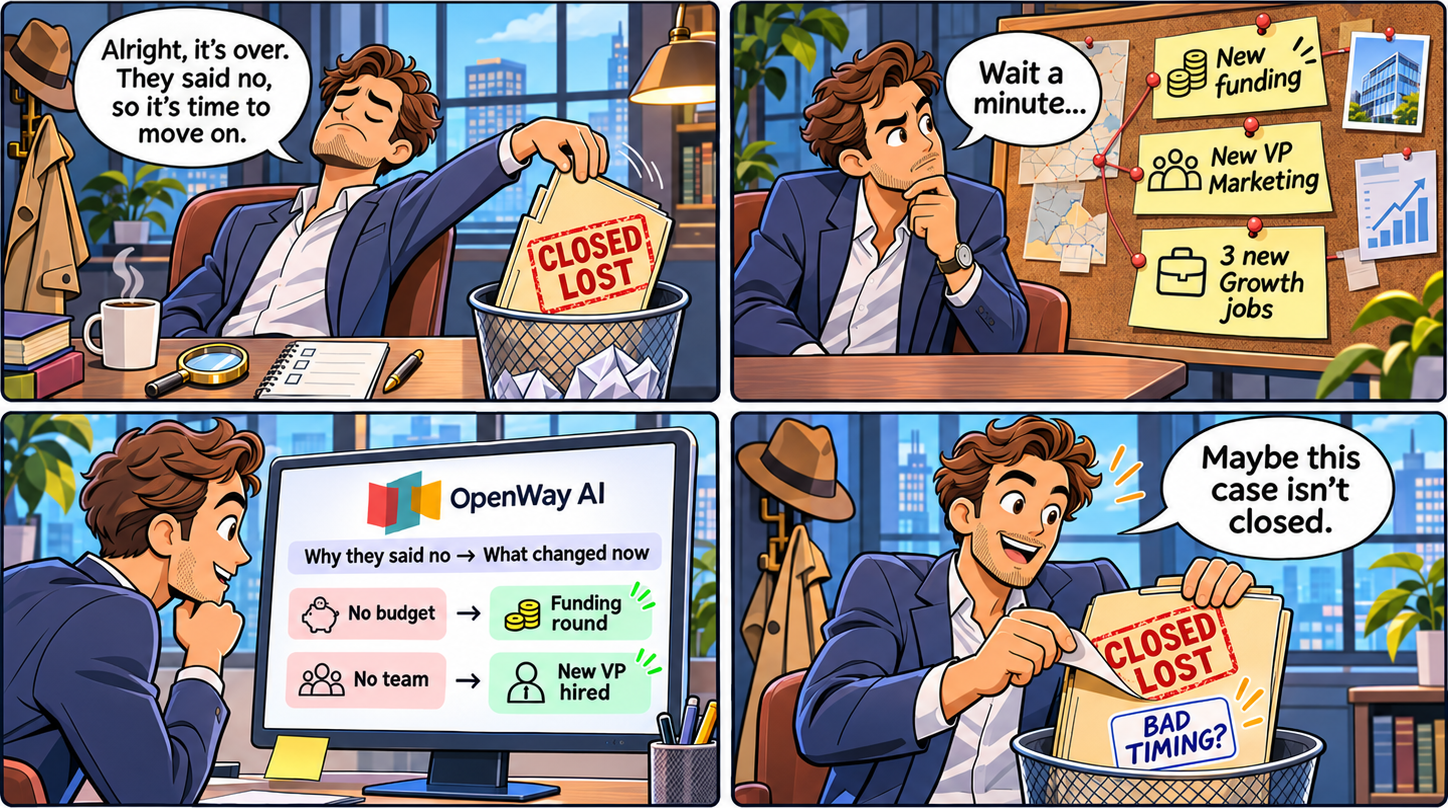
4. Sometimes “No” Doesn't Mean Rejection. It Just Means Bad Timing
Imagine you offered your product to a company six months ago. The offer was interesting, but the deal didn't happen.
There was no budget. The company was focused on other priorities. Or it simply didn't have a team to implement a new solution.
For many outreach systems, that's where the story ends. The contact gets marked as Closed Lost, and the system moves on to finding new prospects.
But let's look at it differently.
Six months have passed. The company has raised funding. Or hired a new VP of Marketing. Or started actively developing the business area where your product could be relevant.
The reason for the initial rejection may have disappeared.
And you may not even know it.
This is where a different approach to outreach becomes possible. Instead of endlessly searching for new contacts, look at what has changed for the people you've already spoken to.
It's not just about spotting a new signal. It's about understanding how that signal connects to the previous conversation.
If someone declined because of a lack of budget, a new funding round could be a reason to check whether your offer is relevant again.
If the problem was the lack of a team, a new leader could change the situation.
And if the company chose a competitor, it may be worth understanding whether its priorities have changed since then.
The important thing is not to start the conversation from scratch. Show that you remember the context of the previous conversation and understand why your offer might be relevant now.
Of course, this doesn't apply when someone has explicitly asked you not to contact them again.
For AI, this is an especially interesting challenge. It is not enough to find potential customers. The system also needs to preserve interaction history, understand the reasons behind previous decisions, and notice changes that could genuinely affect the outcome.
That is exactly what business memory is meant to preserve: what was decided, why, and what happened next.
Sometimes the history of previous conversations is far more valuable than a new list of a thousand cold leads.
My check: Before sending another email to someone new, have we checked whether there's a new reason to talk to someone who already knows us?
5. Use Job Descriptions as a Source of Hidden Business Priorities
Everyone knows that a new job opening can be a useful signal for outreach.
A company is hiring a Head of Growth? That could be a reason to offer them your growth product.
But I'd suggest looking a little deeper.
Job descriptions can reveal much more about a company's real problems and business priorities than the job title alone.
Imagine a B2B SaaS company is simultaneously hiring a RevOps Manager, Head of Growth, and Marketing Operations Specialist.
That could suggest the company is preparing to restructure or scale its growth, sales, and marketing processes.
But the most interesting information usually isn't in the titles. It's in the descriptions themselves.
For example, the RevOps Manager job description might say that the new employee will need to:
- Improve alignment between marketing and sales.
- Make revenue more predictable.
- Improve reporting across the funnel.
- Build more scalable revenue processes.
Essentially, the company is describing problems it is willing to pay someone a salary to help solve.
Now imagine your product can help with some of those problems.
Instead of sending the standard pitch for yet another AI tool, you can explain how your solution might help the future employee achieve results faster. Or how the company could start addressing some of those challenges before the new hire even starts.
That's a much more meaningful reason to connect than simply saying, "I noticed you're hiring."
Of course, an open position doesn't prove that a company has a specific problem. But it gives you a useful hypothesis that you can validate against other sources.
This is exactly where I'd use AI to analyze several signals together: job openings, new products, team changes, funding, and publicly stated business priorities.
Not to write a longer email.
To find a better reason to send one.
My check: What problem is the company trying to solve by hiring this person, and can we offer value before the position is even filled?
Instead of a Conclusion: AI Should Improve the Quality of Connections, Not Just the Number of Emails
I've been working in growth hacking for more than ten years, and during that time I've seen many different approaches to automating customer acquisition.
Today, AI gives us capabilities that simply didn't exist before.
We can research thousands of companies, analyze real business signals, find potential customers, and maintain personalized communication at a scale that would previously have required a much larger team.
But the more accessible these capabilities become, the less competitive advantage automation itself provides.
If everyone can send thousands of personalized emails, volume is no longer an advantage.
OpenWay AI gives your whole team one business memory: what your company decided, why, and what happened next, inside Claude, ChatGPT and Slack. Growth is the first layer that runs on it, using what your business already knows to inform pages, campaigns, demand tests, and outreach.
That matters in outreach because the question isn't simply who to email.
It's what we already know about that person. Why our offer might be relevant. What happened last time. What has changed since then. And what we've learned from previous conversations.
For me, the goal of cold outreach has always been much bigger than getting a reply.
It's about giving someone a reason to want to continue getting to know you.
And if AI can learn to do that at scale, that's when cold outreach becomes genuinely more interesting.
Want to see what OpenWay AI can find in your own business?
Start with a GEO/SEO audit of your website and see what could be improved for both traditional search and AI discovery.
Share this article